
SECTION ELEVEN
“Take care, beware of thoughts that linger”
George Harrison
“And what a long and weary way it was”
Starting off this section, the first sentence hints of the appliances’ journey moving away from the mostly rosy and innocent experience it has been and into what will become a darker one.
“stretched on seemingly forever”
Unlike in Disch’s short story Let Us Quickly Hasten to the Gate of Ivory where the setting there does exactly that.
“a tree would have taken a different view”
Once more the consideration of alternate points of view is brought up again, this time something the appliances have not interacted with in terms of conversation, though it seems trees are not actually capable of speaking and might be more of a hypothetical the narrator is presenting to the reader.
His use of trees also occurred in his other fiction, the narrator of the short story His Own Kind being a nymph who takes on the form of a tree. Another personified tree appears in The Grown-Up. In the novel The Businessman the protagonist at one point inhabits a tree. In The M.D. the protagonist uses his newfound powers to heal the trees in his neighborhood.
“tend to see others are alike and how we differ”
As was demonstrated in the explanation for the Polish joke in the previous section.
The theme of the loss of identifying individuals from a group shows up in Disch’s short story The Apartment Next to the War.
It also occurs in Chanson Pérpetuelle where the main character and her uncle visit a zoo to which, as they observe the lions, the following exchange occurs:
“’You know.’ August cleared his throat. ‘One never is aware of them as individuals. This one, for instance—he might be the same lion I saw when Joanna brought me here in ’thirty-six.’
“She had decided that August had indeed come to the end of his thought and was about to remark that the attendants, working with them every day, probably did have a clear sense of each animal’s unique character, when he resumed. ‘Of course, one doesn’t see most individuals as individuals.’”(134)
“the world is full of a great deal more variety than we ever manage to take in”
As was exemplified by Harold’s and Marjorie’s views on biological sex as being either male or female.
“lost sight of this important truth”
Now the appliances themselves are demonstrating a similar shortsightedness.
“very bored and impatient”
The novelty of the forest as was seen by the appliances at the beginning of section eight has now faded and no longer interests them anymore.
“worn to a frazzle”
The story now transitions into the narrator’s reveal of the visible degradation of the appliances.
“Rust spots”
The most recognizable form of decay for an appliance starts the sentence like a sudden and unexpected punch.
“inside it as well”
The toaster should have brought some kind of covering to shield its slots and exposed coils. Yet it may not have found anything practical, let alone considered the possibility of such a need.
“stiffness”
The same impediment afflicts the protagonist of Disch’s story Descending.
“poor thing”
Of the five, the blanket is the only one to be pitied by the narrator for its weathered condition.
“the radio seemed not to have suffered damage”
As to be expected from an object that’s outside shell is made of plastic, as was pointed out at the story’s beginning back in section one. As stated in the corresponding note, this will play a role in the misfortune, and subsequent fortune, to come.
Its maintained condition can also be seen as symbolic. Due to the radio also being a clock, this could be interpreted as the notion that time keeps on going, never slowing or stopping.
“put on the scrap heap”
Another allusion to death.
“a dreadful reward for so much loyalty and devotion”
The main character of Disch’s The Apotheosis of Richard Philo gifts his followers in a similar way for their faith in him.
“not notable for his tender conscience”
The appliances seemed in denial of this trait when they wholeheartedly believed their master would never knowingly abandon them.
The protagonist’s mother in Disch’s The Silver Pillow views her son in a similarly detached way as more of a servant than as her child. In The Shadow, the main character’s son, shirking the idea of his Alzheimer-diagnosed mother coming to live with his family, chooses to consign her to an adult home.
On the subject of denial, that is touched upon in his novella The Proteus Sails Again:
“The power of denial is on a par with the power of faith.”(135)
In The Burial Society, one character says the following:
“’It’s not that unusual, and it’s nothing to be ashamed of. Denial is a useful psychological tool when the alternative is despair.’”(136)
“Its own predecessor”
Like a repressed memory unearthed by present circumstances, the first of the two other toasters of the story appears in the Sunbeam’s thoughts.
“the dump”
Another death reference.
This fear of being thrown away is also shared with the protagonist of The Happy Turnip. In This Little Pig Had None it is the market and the slaughterhouse that are that character’s symbol for death.
“its chrome had been worn away in patches”
The elder toaster’s defects echo the Sunbeam’s earlier mentioned spots.
“In its youth”
How long is an appliance’s youth? The toaster’s service to the master was implied to be brief. From between being delivered to the cottage to the master leaving for the last time for the city, that would be about half a year at most. This must be so as the toaster never went to the city while the others had and if the master had left a newly bought toaster behind the story would surely have brought it up.
“but now”
Crumbs in the other tray now, pun intended.
Take note also that the preceding paragraph serves as a set up for what is to unfold in section eighteen.
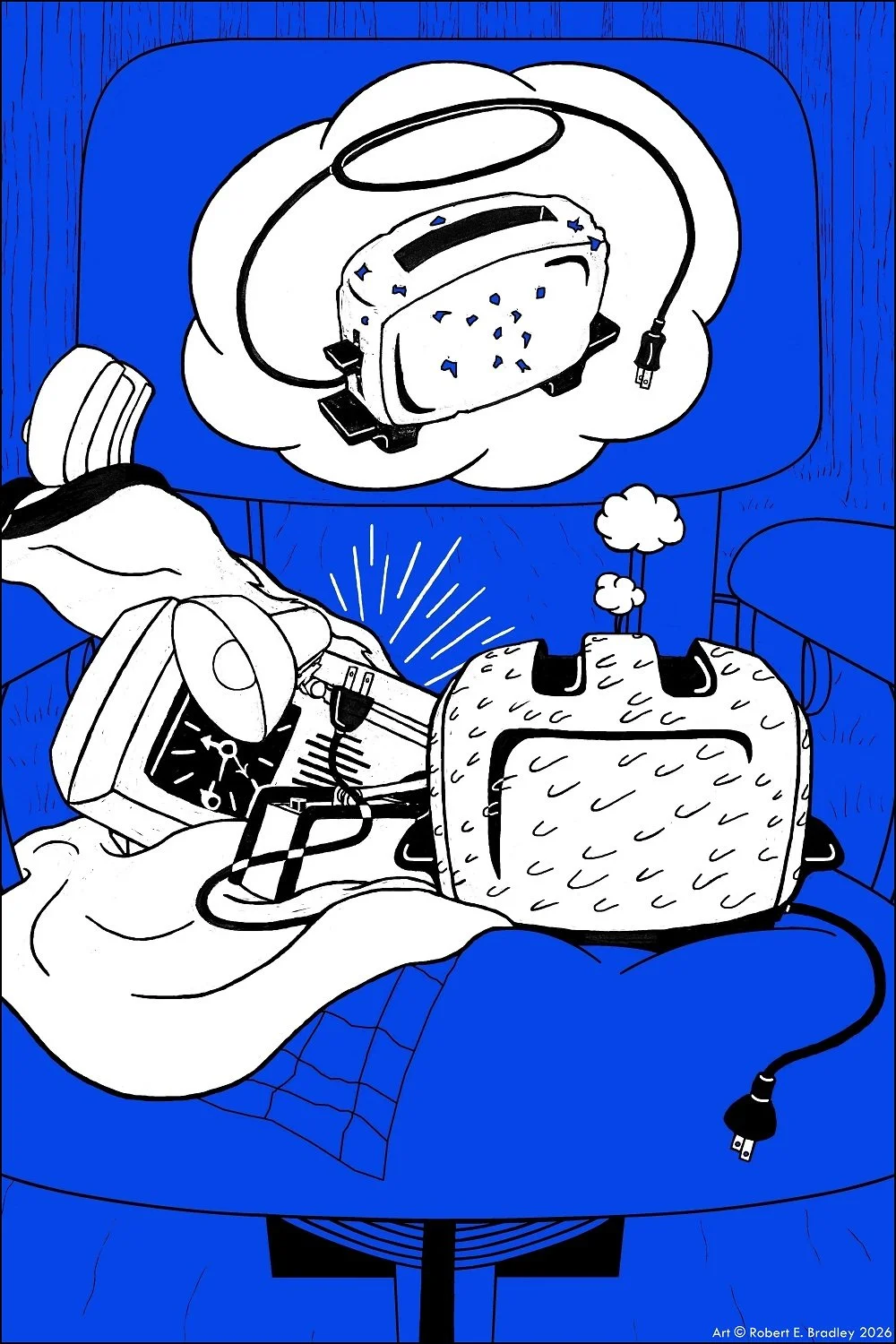
“better not to think about such matters”
Another instance of a sudden end to an unpleasant train of thought like the one in section eight.
SECTION TWELVE
“Seasons don’t fear the Reaper”
Blue Öyster Cult
“a wide river”
The single largest body of water in the whole story. To the appliances it might as well be a never ending brick wall or an immense chasm.
A passage in Disch’s novel The Sub makes this observation:
“No one is ever lost in the woods, for they follow, like water, the course of least resistance, traversing the paths made smooth for them by the deer and other denizens of the wilderness. Those paths may not lead where they would like to go, of course.”(137)
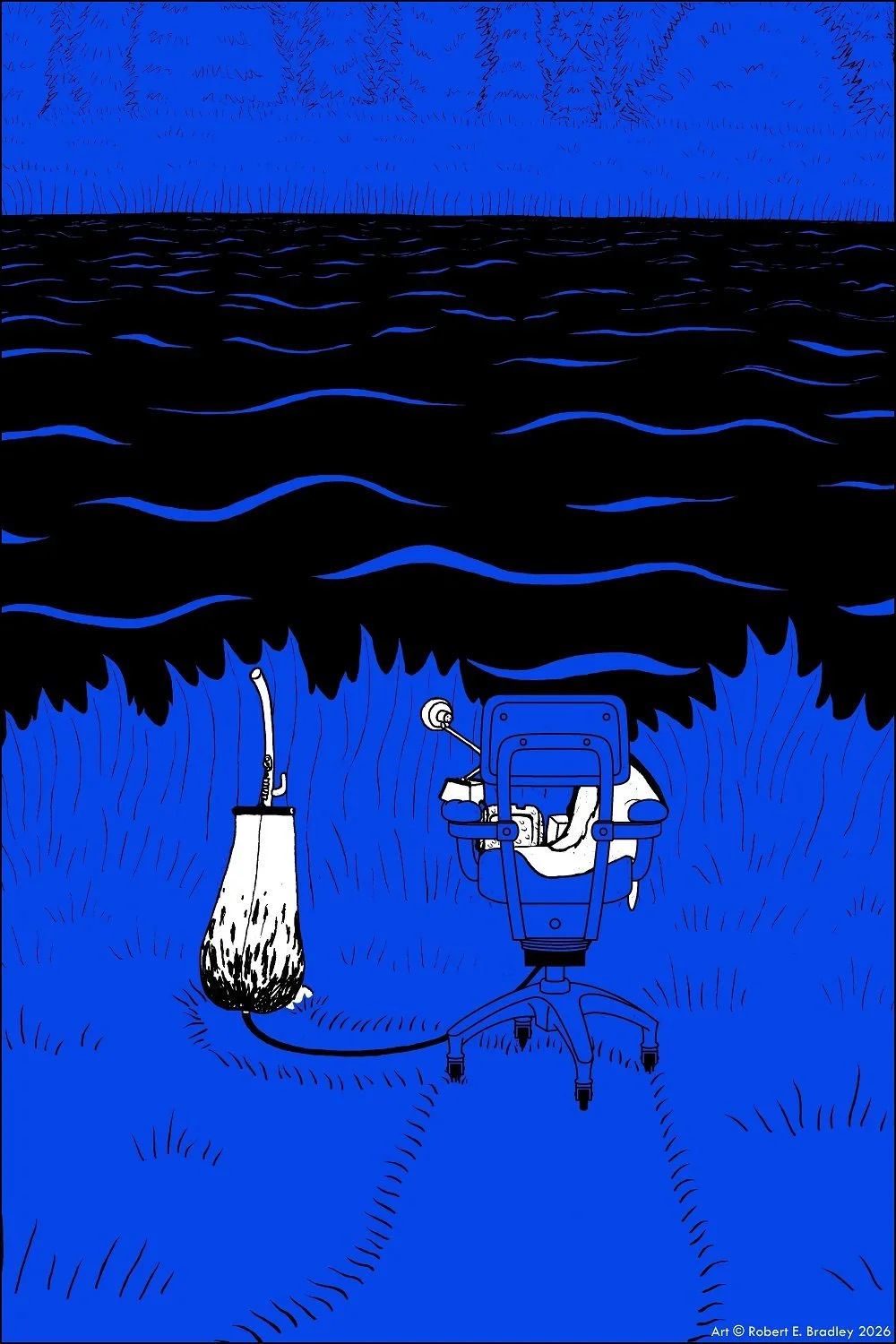
“water”
The association of water with decay and death, as was pointed out in earlier sections, appears often in Disch’s fiction, whether it be in the form of a lake, rain as was seen in sections eight and ten, a river here, etc.
Additional examples of this include the short stories The Double-Timer, Leader of the Revolution, The Empty Room, The Beginning of April or the End of March, A Kiss Goodbye, Carousel, The New Me, The Girl with the Vita-Gel Hair, Palindrome, The Silver Pillow, Voices of the Kill, Celebrity Love, the novels On Wings of Song, The Businessman, A Troll of Surewould Forest, and the Proteus novellas.
“incoherent in its distress”
The second time the vacuum looses its composure under the pressure of the undertaking.
“turn me off”
Depending on how one could interpret this exclamation from the Hoover, this may possibly be a death reference.
“ran over its own cord and started chewing on it”
The protagonist in Descending does the same thing to his hands.
Also, characters in Clara Reeve, The Fire Began to Burn the Stick, The Stick Began to Beat the Dog, and On Wings of Song go through a similar self-destructive fit.
Nervous breakdowns are also relevant to the story A Kiss Goodbye where this observation is made:
“‘I think almost everyone has a time when he goes off the deep end.’”(138)
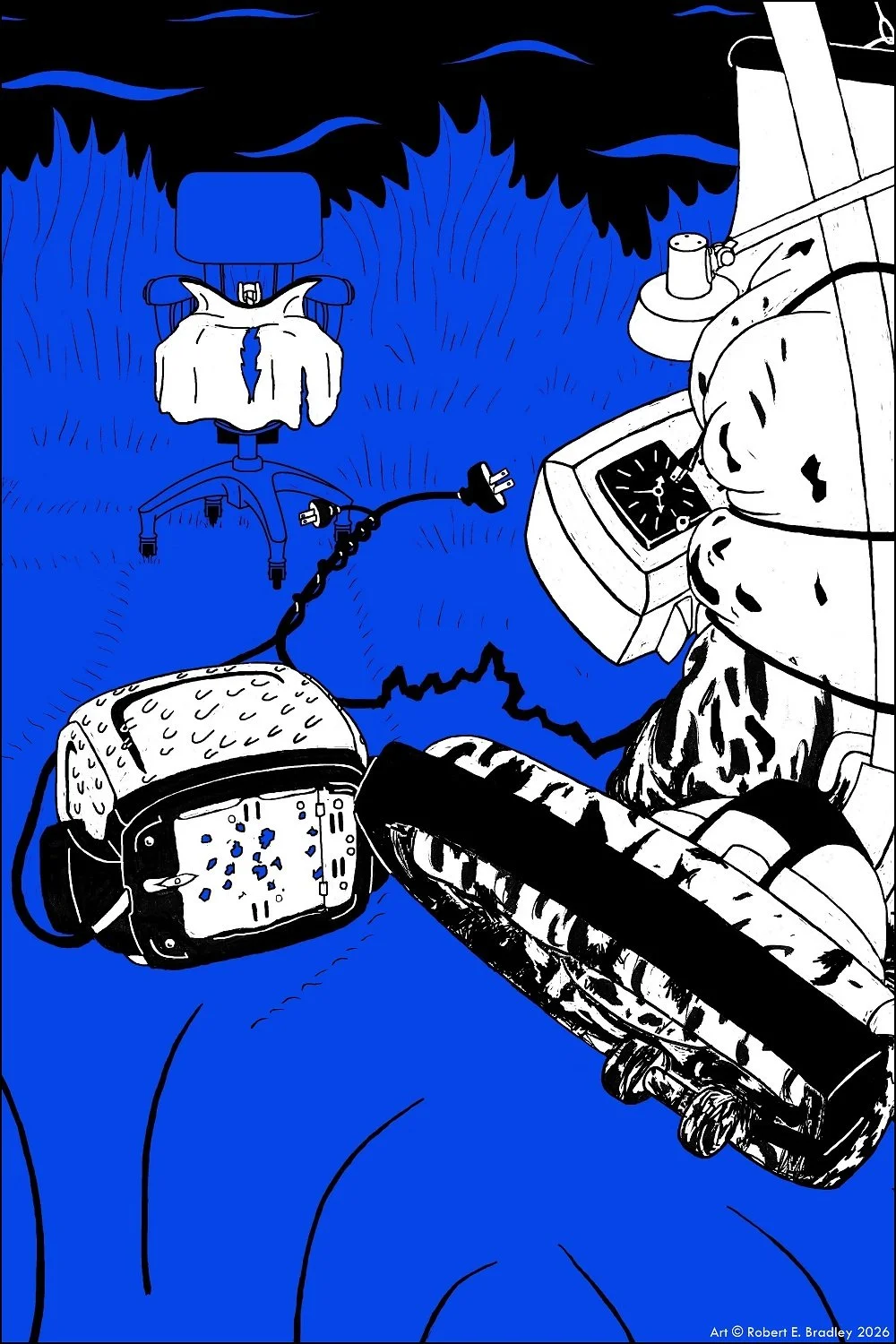
“carpet-sweeping swathes”
To remind the Hoover of its duty and what would bring it most happiness.
“the battery was now too run-down”
The imagery of a dying car battery also occurs in On Wings of Song, Celebrity Love, The Shadow, and The Proteus Sails Again.
Along with the Hoover’s concern about the battery in section ten, it is quite possible that the 1973 oil crisis which heavily effected the US and world economies for the rest of that decade may have been a real life parallel that Disch was inspired by.
“could not go forward and could not turn back”
The same fate also befalls the protagonists in Descending and The Number You Have Reached.
“soon”
Time now takes on a more ominous tone for the travelers than it did when they were within the safety of the motherly, womb-like cottage.
“inclemencies”
Not just more rain but the increasing cold and with it the beginnings of frost, the same weather the protagonists in Disch’s short story The Birds begin to suffer due to their delayed flight.
“winter”
Winter is also the setting of the doom laden The Number You Have Reached.
In This Little Pig Had None, when the truck comes to take animals way to market it happens in winter.
Within the novel The Word of God, Disch presents and discusses a poem of his titled The Moon on the Crest of the New-Fallen Snow which includes the line “The loss of leaves, of love, of life. Eternal”.(139) But in the same novel he discusses both the light as well as the dark aspects of that particular season.
“buried in the snow”
Not just a death reference but the image of being buried alive.
To quote its sequel, “the same as water, only different.”(140)
The imagery of being buried in snow also appears in The Number You Have Reached, Clara Reeve, and The M.D.
“Hoover’s rubber belt would crack”
Long after it had mentally done the same.
“forces”
As the old saying goes; Nature is a cruel mistress.
“destroy”
Another death reference.
The protagonist in Voices of the Kill recalls a poem’s haunting refrain:
“The woods decay, the woods decay and fall”(141)
It is possible that this morbid yet compelling image of man-made objects rusting away in the snow had found its way to Disch’s psyche some years earlier:
“I used frequently to walk about the wooded hills just outside Milford [, Pennsylvania]. Some years before real estate developers had thought to subdivide these woods into lots, and as a result, an incongruous, wide gravel road wound about through the pines and hemlocks. Various pieces of road equipment had been abandoned along this road, and these machineries were gradually becoming part of the landscape. During one day-long hike one of these rusting machines captured me and held me the way a painting can when you’re ripe for it.”(142)
“months—or even weeks”
According to the clock radio’s time keeping in section eighteen, the fall equinox is actually merely days away.
“unable to work”
Along with being a death reference and the same fate the air conditioner received but it will be for them, ironically for the toaster and blanket, out in the cold.
“inevitable progression of events”
In Clara Reeve, the main character makes a similar epiphany on being struck with a sense of dread:
“Most [moments] go unobserved in our haste towards what we still fail to recognize as our appointed end, but one moment necessarily stands out from the common ruck—that moment when we first recognize that we are on a downwards course and can discern the awful, inescapable shape ahead.”(143)
“What were they to do”
Now the next problem to solve is addressed; how to cross the river without getting wet and carried off by its current.
SECTION THIRTEEN
“I can feel the hand of a stranger”
Grand Funk Railroad
“power lines”
In the Family outline, Disch wrote this sentence:
“They marvel at the great power lines.”(144)
“like a sudden surge of current”
As a power line should.
“Let’s look at the map again”
So, the map was not “quite useless” after all.
A similar business with a map occurs in Disch’s novel A Troll of Surewould Forest.
“Magic Marker”
Sidney N. Rosenthal, inventor of the Magic Marker, put it on the market in 1952 and sold the rights to the name in 1970.(145)
“only a quarter-inch from the pink patch of the city, they found the wavery blue line that had to be the river they’d come to”
Here another clue appears as to the city they are headed to.
“to have forgotten all about it”
It is not at all a coincidence that the narrator applies this notion of things forgotten to this detail in the map.
“Hurrah”
In the short story Dangerous Flags as well as the novels On Wings of Song, A Troll of Surewould Forest, and The Word of God Disch makes use of this same exclamation.
“the Hoover, who wasn’t so easily convinced”
This is consistent with its previously implied, and outright stated, doubtfulness to the success of this whole journey.
“the office chair, getting a leg mired in an unremarked patch of mud, was overturned”
Another, this time literal, stumbling block.
“wheel that had come off the chair”
Knowing that the mattress had a wheel for each of its corners and the fact the office chair has had no balancing issues, the office chair must have four legs. With a wheel missing, the chair would be bound to risk tipping over again if they were to continue on without it.
A similar incident happens during a ride in a canoe with one of its paddles in Voices of the Kill.
“spreading the stains”
The protagonists of His Own Kind, Clara Reeve, The Shirt’s Tale, The Short’s Story, A Troll of Surewould Forest, and The Sub find themselves in the same predicament
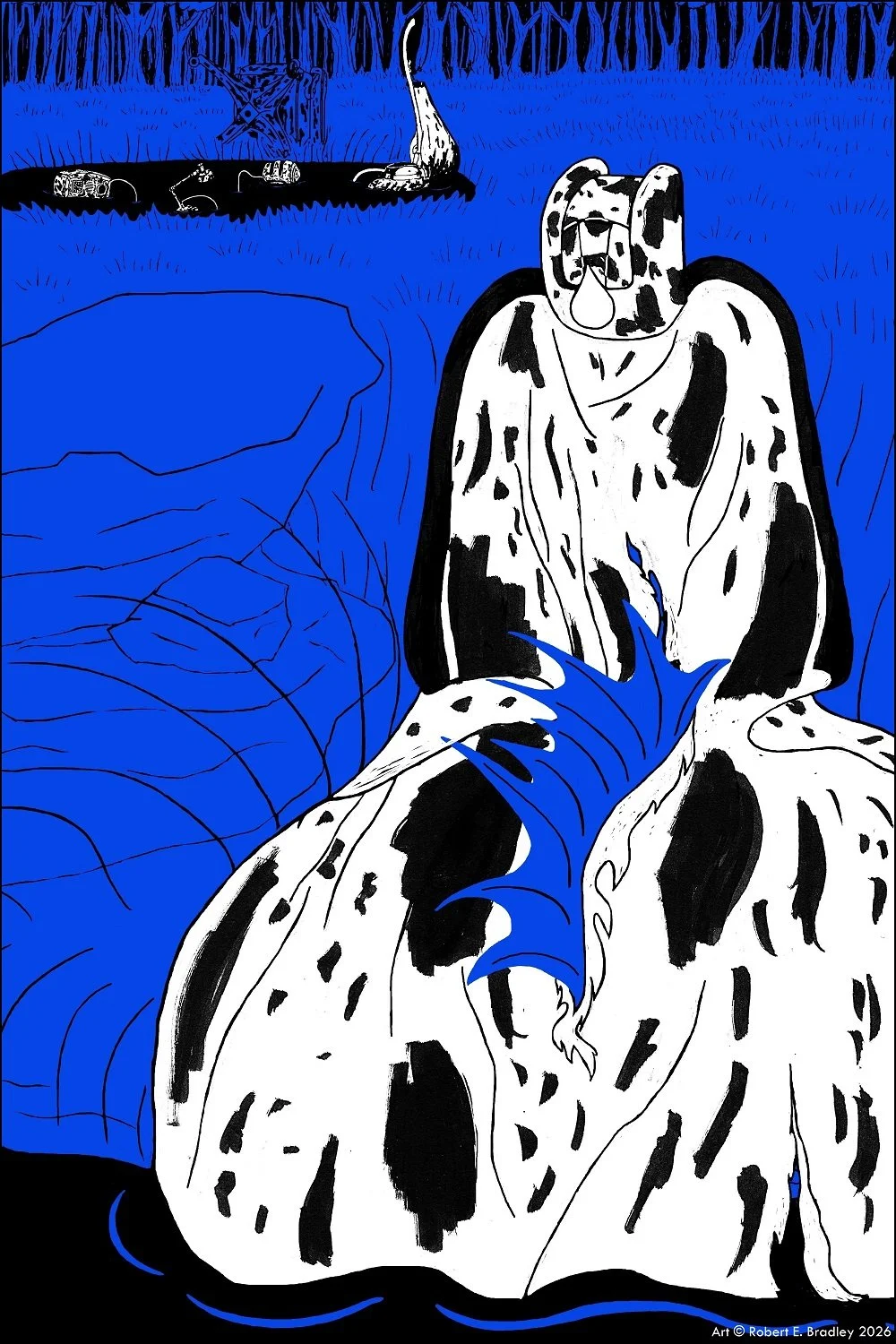
“one big puddle”
An ill sign resides within the boat that poses an answer to the appliances’ problem.
“expensive motor”
And an old one by 1976 as Chris-Craft outboard motors were only in production from 1949 to 1953.(146)
“How providential”
Does the vacuum believe in things being more than coincidence or it is just a figure of speech?
The notion of providence/fate is also brought up in other works by Disch, such as Celebrity Love, The Burial Society, The Proteus novellas and the novels The M.D., The Priest, and The Sub.
“You don’t intend for us to use this boat, do you”
Thus begins a debate between the vacuum and the toaster on the subject of whether taking something that is not theirs, the boat, constitutes as theft or not.
Characters are often debating all sorts of things in Disch’s work such as the novels Camp Concentration, Clara Reeve, On Wings of Song, A Troll of Surewould Forest, short stories like The Birds, Josie and the Elevator, and even in poems like The Dirt and the Willow and Coming To.
Speaking of debates, this is yet another parallel to Alice’s Adventures in Wonderland where Alice finds herself constantly in battle after battle of arguments with the denizens of Wonderland.(147)
The same also happens in Looking-Glass.(148)
“Who knows how far it may be to the bridge”
The vacuum takes the utilitarian approach to its side of the argument. The battery’s limited, possibly dangerously low, power must be a consideration in the vacuum’s mind. This would have been a way of strengthening its point had it brought it up.
“no better than...than pirates”
The toaster, on the other hand, goes for a moralistic angle.
“no fate, even obsolescence, so terrible”
That is to say being stolen is a fate worse than death for an appliance.
“Who ever heard of an appliance that was a pirate”
The Hoover seems under the impression that appliances cannot, as the previous paragraph described, be classified as pirates since the descriptor applies to people and not appliances. But if appliances have a consciousness, as they do here, and a will of their own, then the possibility of appliances committing theft is not altogether nonsense as the Hoover earlier declared. If they were to take this boat that is not theirs, them being appliances would not negate the toaster’s point of being no better morally than pirates. If they were not pirates by technicality they would be something on par. The Hoover’s logic is flimsy at best, contradictory at worst.
“We wouldn’t keep it”
The Hoover must be trying to account for the hole in its logic. By qualifying that theft is taking something that isn’t yours and not giving back to its original owner makes what the Hoover is proposing not count as theft thus they would be more moral than a pirate.
“It’s the principle of the thing”
The toaster hammers home its moral point, regardless of peripheral circumstances.
“Oh, as for principles”
Just as the toaster seems to be winning this debate, the radio, who has chosen to side with the Hoover, cuts in to give its explanation as to why taking the boat is not an immoral action.
“to his need”
Being acquainted with hearing debates, the radio can supply an argument that the vacuum, toaster, nor any of the others could know of, unless they happened to be listening to those same debates on top of caring to remember them.
Being acquainted with hearing debates, the radio can supply an argument that the vacuum, toaster, nor any of the others could know of, unless they happened to be listening to those same debates on top of caring to remember them.
As an author whose career spanned the majority of the Cold War, Disch brought up themes of capitalism, socialism, and communism on occasion in his work.
Focusing on the phrase the radio quotes, “from each according to his ability, to each according to his needs”, it has been erroneously attributed to political and economic theorist Karl Marx.(149)
The saying itself was already ubiquitous in Marx’s time, utilized by various socialist movements with the earliest known use of the exact phrase being from about 1840 by Louis Blanc.(150)(151)
But a similar sentiment was penned by Morelly, here translated to English from the original French, dated 1755 from the first law in his Sacred and Fundamental Laws:
“Nothing in society will belong to anyone, either as a personal possession or as capital goods, except the things for which the person has immediate use, for either his needs, his pleasures, or his daily work.”(152)
But another written work predated Morelly’s words by over a century; titled the Guilford Covenant, signed by the founders of the town of Guilford, Connecticut in 1639 stated within it:
“...be helpful each to other in any common work, according to every man’s ability and as need shall require...”(153)
Yet within the pages of the New Testament of the Bible, in this case specifically what is known as the Tyndale New Testament, written in 1525, in Acts 4:34 to 35, is written:
“Nether was ther eny amonge them that lacked. For as many as were possessers of londes or housses solde them and brought the pryce of the thinges that were solde
“and layed yt doune at the Apostles fete. And distribucion was made vnto every man accordinge as he had nede.”(154)
In the corresponding passages of the English Standard Version, it goes like this:
“There was not a needy person among them, for as many as were owners of lands or houses sold them and brought the proceeds of what was sold
“and laid it at the apostles’ feet, and it was distributed to each as any had need.”(155)
In addition, the Ancient Romans had something of a similar nature called obligation in solidium in which “[e]veryone assumes responsibility for anyone who cannot pay his debt, and he is conversely responsible for everyone else. Free riding is ruled out legally, without appealing to morality. The bind of solidarity is solid not only for the debtor community itself but also for the creditor, who can, if necessary, turn to the surrogate who is able to pay.”(156)
“hopped onto the foremost seat of the rowboat”
Like a checkmate, the radio’s action puts an end to the debate.
“the Hoover heaved the office chair”
How strong is the vacuum to lift and toss an office chair without any assistance? Quite, apparently. Also, it seems, unlike the blanket when it was stuck up in the tree, to not be in any pain after chewing its own cord.
“The boat settled deep in the water”
Another bad omen. If the boat were to sink, not only would the radio go down with it but so would the chair with the battery as well. The remaining appliances would then truly be fatally stranded.
“toaster’s accusing look”
Though it does not press its point further, the toaster is still not convinced of the vacuum and the radio’s appeals. At this point it can only hope that the blanket and the lamp will side with it, getting the majority vote and thus rejecting the idea of using the boat as was done back when the radio proposed they go after a fox.
Though even if this was to happen, could the vacuum haul the chair and battery back upon the riverbank without risk of incident? And if it could, would it be willing to even do so?
“blanket took a seat beside the radio”
With the blanket’s vote, the majority now side with the Hoover. It’s implied the blanket might have been less decisive had it been facing the toaster.
“something made it stop”
Though the toaster seems about to concede to the debate, its principles are to be left unsoiled.
With what unfolds towards the end of section seventeen there must be some kind of sixth sense that causes appliances to know to freeze like this rather than something completely beyond their control, like a form of muscle memory.
“the owner of the boat had returned”
The very first human to appear in this tale.
“a fishing rod”
Like fish, the appliances have taken the unintentional bait.
“some visitors”
An echo of Harold’s words of greeting.
Now, consider this: if we switch our perspective over to this person, he must be assuming one, or multiple, people are carrying a toaster, a lamp, a clock radio, an electric blanket, a vacuum cleaner, and an office chair with a battery strapped to it, all of which are in various condition from good to “almost in tatters.” He would probably guess that they are the possessions of homeless people who are camping about the woods and have gone, much as he has, to catch food.
“a manner so rough and ill-mannered that it were better not to repeat his words verbatim”
This theme of strong language alluded to but not directly spoken along with that of censorship is something Disch played with to varying degrees in his fiction. Examples include the short stories The Sightseers, The Empty Room, His Own Kind, The Foetus, Josie and the Elevator, the 1980 version of The Pressure of Time, The Grown-Up, The New Me, Torturing Mr. Amberwell, The Silver Pillow, The Shadow, The Proteus Sails Again, as well as his novels On Wings of Song, The M.D., The Priest and, especially central to its plot, A Troll of Surewould Forest.
“the owner of the appliances”
Unless this is a typo and Disch meant to say “owners” then the “visitors” he was addressing were the objects in and by the boat.
“by way of retaliation, to steal”
Characters stealing show up in several of Disch’s works including The Foetus and The Invisible Woman. In The Grown-Up, not only does theft occur but also the protagonist steals from the thief in a similar act of retaliation.
“nevermore to be seen”
The final treatment the office chair gets seemingly implies that the appliances most likely failed to find the missing wheel in the mud.
As an aside, one could see the office chair as a representation of their old master (a king’s throne, you could say) and with this act the appliances no longer belong to him.
“pirate”
Who is now their new master.
“set off”
According to the Rest outline, a deleted story point was intended to occur after the discovery of the boat:
“Later the blanket learns to use the power of the wind, when it helps his friends cross a river, acting as a sail.”(157)
This indicates that its flight through the air on the night of the storm was originally intended to set up for how they were to use the boat to cross the river.
On the subject of dealing with fear in stories for children, Disch wrote:
“The most terrible fears are often those we are not allowed to express and which must therefore be displaced to a permitted bogey. The witch who enslaves and imprisons Hansel and Gretel is not, heaven forefend, their mother, or even their wicked stepmother, but an Other.”(158)
Fittingly, Toaster and company suffer their worst luck here in the thirteenth section.