SECTION NINE
“From my experience, it just doesn’t seem to make sense”
Emerson, Lake, and Palmer
“set itself, as usual, for seven-thirty”
In line to its previous routine at the beginning of section four, the clock radio goes off at its designated time.
Another thing of note is that because of its sticking to its literal time held duty, this indicates that the radio was not just using the battery to imitate the birds, recite commercials, and play music, it had to be using it since they began their travels due to its own lack of back-up batteries.
“awake well before the hour”
Their sleep is easily disturbed by the newness of their surroundings.
“strung like miniature power lines”
Here we are looking at nature the way electric appliances would see it.
The protagonist of Voices of the Kill perceives a similar wilderness in his own electronic way.
In his 1998 essay The Third World and Other Alien Nations Disch wrote the following:
“For what can any of us suppose about what is unknown to us, except by reference to the nearest thing it might resemble.”(102)
“mushrooms”
In the Family outline Disch wrote:
“The toaster toasts mushrooms.”(103)
The imagery of mushrooms also appears in Voices of the Kill, A Troll of Surewould Forest, This Little Pig Had None and the poems The Mushroom’s Salon and minor poets are human too.
“frosted light bulbs”
Again, an appliance’s view of nature.
Disch wrote of his short story Et in Arcadia Ego, a story where a crew of explorers lands on the titular planet experiencing its flora, fauna and culture, this:
“[N]ever again did I attempt that theme [after writing The Chthonian Smell “in lieu of a term paper, to Maurice Baudin, Jr., with whom I was taking an evening course, ‘The Novella,’ at NYU”] which more than any other defines sf—the exploration of another world, the encounter with alien forms of life. I prided myself that I understood what such tales were about better than anyone who was actually writing them. Indeed, the chief obstacle in the way of my creating my own avatar was that I had so many and such various theories. First, such stories were about sex. (What stories aren’t?) Then, about the emergence of the United States as an imperial power. Then, though less necessarily, about man’s relationship to machines and to himself considered as a machine: related to this theme was a curious lack of affect that usually seemed to obtain between the crew members on these expeditions. If I couldn’t write the story that I glimpsed through all this theoretical foliage, I was content that no one else had been able to either.”(104)
“As, of course, it must be—to a degree. The demand for a totally transformed environment, pushed to its limit, would require a writer to invent a new language for each story he writes. But the sense of such a shift having taken place can be suggested, and when it is, the result is that touch of strange that is the raison d’ etre for sf.”(105)
It was after he was inspired to write Et in Arcadia Ego he came to a new conclusion:
“’A pastoral!’ I thought. ‘That’s what all those stories always are—pastorals!’”(106)
Considering Disch’s observation, The Brave Little Toaster would classify, the greater middle part of the tale at least, as a pastoral of sorts.
“a real fox”
The imagery of the fox appears occasionally in Disch’s fiction such as Concepts, The Burial Society, and This Little Pig Had None.
“wanted to go off after it”
In On Wings of Song the protagonist ponders on the hobby of fox hunting and comes to this conclusion:
“But the fox, he saw now, was only a pretext, an excuse for the hunters to go galloping off across their demesne, leaping walls and hedges, indifferent to boundaries of every kind, because the land belonged to them so far as they could ride and sing out ‘Tally-ho!’”(107)
“The blanket grew quite upset”
Here again the blanket is emotionally vocal in its objections.
“appreciate the blanket’s point of view”
As established right from the subtitle, considering the perspective of others, it is directly mentioned here.
All across the creative writings of Disch, this theme comes up over and over again, sometimes very subtly and other times stated outright by the narrator or one of the characters. The main characters in The Birds and The Shirt’s Tale, The Short’s Story carry out the theme in the latter way as Toaster does.
“they continued on their way”
Strangely, we never get the Hoover’s opinion on the matter.
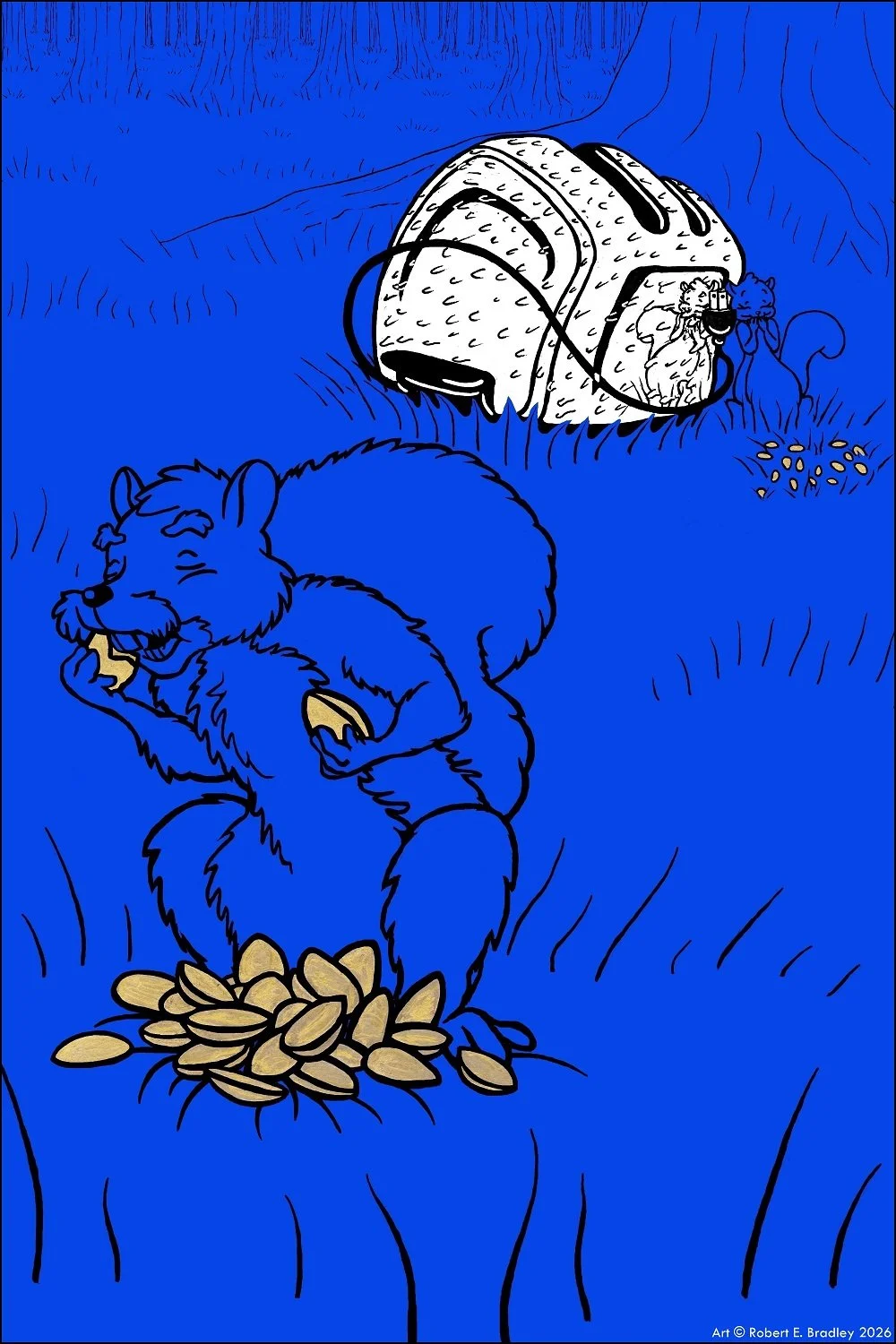
“a squirrel”
The squirrel is an animal that must of held some significance for Disch for he refers to them often in his works. They are included in his short stories Descending, This Little Pig Had None, and the poem Nightmare on Elm Street, even going so far as to title a short story The Squirrel Cage and even dedicated a poem to one in the aptly titled The Squirrel.
They also make appearances in three of his Supernatural Minnesota books; The M.D., The Sub, and The Priest.
“I’m Harold”
Harold certainly heralded himself to the appliances.
“And this fair creature”
And here he heralds again.
“Marjorie”
Disch also used this name in his short story The Vengeance of Hera, or Monogamy Triumphant, coincidentally published the same year as Toaster.
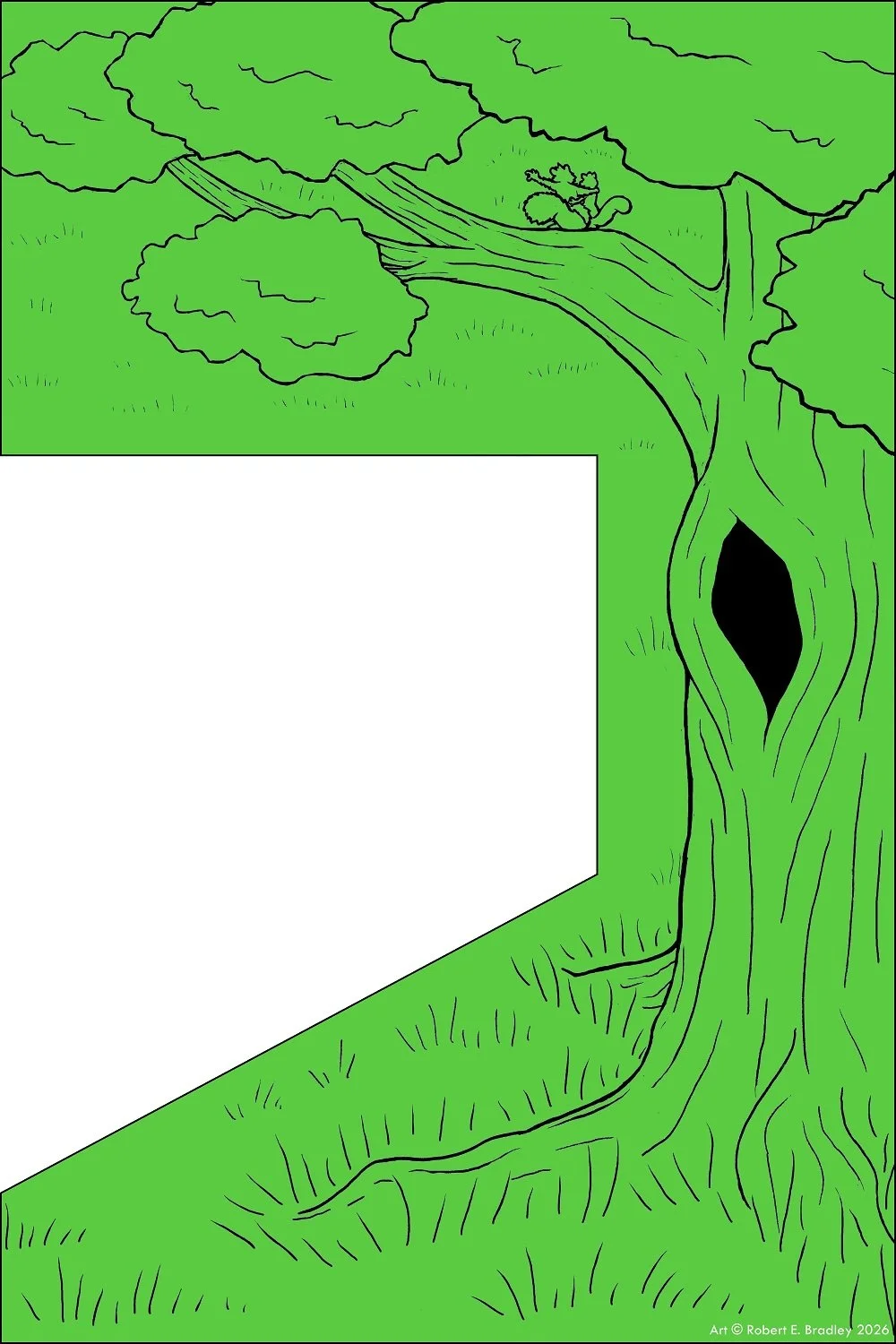
“We don’t have names”
Here another parallel to the Alice books appears, appropriately enough, in reverse to Looking-Glass. In the third chapter of that story Alice deals with the concept of names, even entering a wood in which those who live and go in it have none.
Looking to Disch’s other works, the subject of names comes up in Concepts, when the protagonist asks for the last name of who she’s talking to he replies that he hasn’t had one since he got divorced. In Voices of the Kill when the two primary characters meet, one of them asks for the other’s name. When the other gawks at her, she replies “‘How can we talk to each other if I don’t know your name?’”(108)
“which of you are men and which are women”
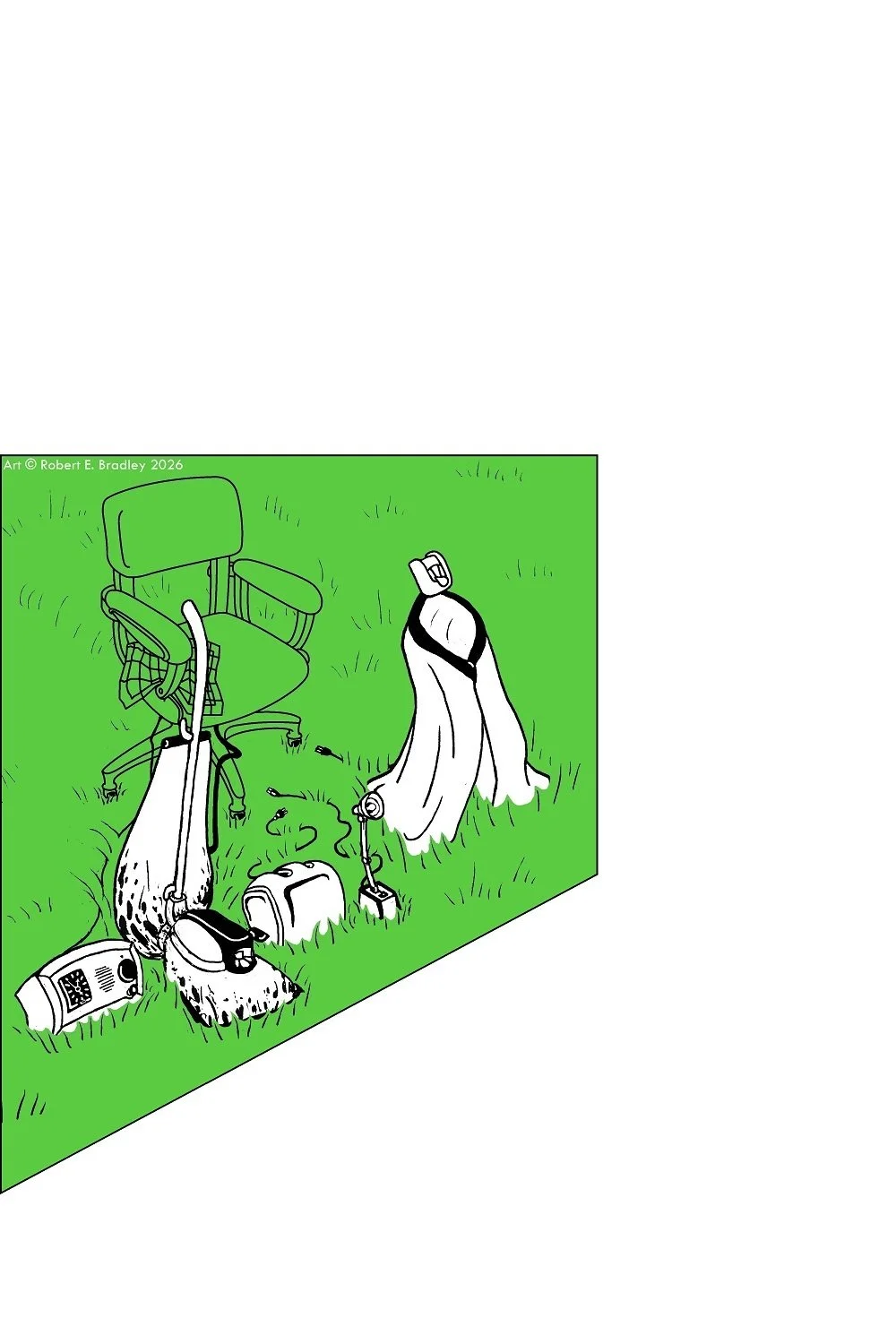
It’s as if the squirrels were humans asking a group of aliens of their nature and how it compares to their own. Culture shock (pun not intended) is inevitable.
In an introduction he wrote for his short story Concepts, Disch reflected on his rare forays into stories relating to third kind encounters as “analogs for our experience of other people’s intractable oddness, which can be a source of amusement or of paranoid frenzy, according to the author’s temperament. But to treat aliens in this way is usually a form of camouflage, obscuring rather than emphasizing one’s meanings.”(109)
Also, here is yet another parallel to both Alice books, where animals can speak and get into arguments as to how things work in their respective worlds.
“can’t alter a universal law”
Harold and Marjorie can’t consider life being any different from, as the appliances felt in their cottage, “their countrified ways.” Then again, from the squirrels’ perspective, the appliances are just as alien to them as the wilderness is to the appliances.
A character in Disch’s short story The New Me gives the protagonist a similar amount of intellectual room for differing points of view despite their friendliness.
“appliances didn’t eat anything”
In the biological way, no. The closest thing they “eat” would obviously be energy in the form of electricity.
“I don’t know any jokes”
Here is an instance of an appliance’s lack of imagination as Disch described, brought up in notes for section five back in part one.
“‘Oh, I do,’ said the radio”
The radio, being directly connected to human culture, would know jokes.
As one character says in The Priest, “‘You want to break down barriers, you tell jokes.’”(110)
This notion of trading jokes as a social connection is also utilized in The Word of God.
“The squirrels”
Interestingly, in the 1987 Hayakawa edition, Azuma depicts Harold and Marjorie as chipmunks though he had them as squirrels in his illustrations for the December 1981 S-F publication.
“Which are the men and which are the women”
With Harold still stuck on this question it implies that he imagined the “three Poles” in the joke as appliances since he would have no idea what a Pole, being Polish, or what the country of Poland, even is.
“not fair to Poles”
In a letter dated March 26, 1987, then President of the Polish American Congress Frank Milewski wrote to Doubleday raising concerns over the preceding joke where he stated the following:
“Considering that any type of humorous anecdote would have been sufficient to accomplish the author’s objective of introducing a joke into this part of the story, we cannot help wondering why he went out of his way to select something which insults a specific minority group. It would be totally inappropriate, we firmly believe, to describe any class of people in such a derogatory manner.
“What is so distressing to us is the fact that this is a book for children. At this early age, they are actively developing impressions and attitudes about other people which will become an integral part of their character and will be carried into adulthood. To needlessly insert an ethnic joke completely extraneous to a children’s story not only does a disservice to your youthful readers but promotes an acceptance of contempt for others.”
Further on he wrote: “Among the members of our organization are persons who were in Poland at the time of the German occupation. In discussing your book with us, they could not help becoming upset with the way Mr. Disch degrades our ethnic group to his young readers. It stirred bitter memories of how the Nazis considered Jews and Slavic people like the Poles as sub-human ‘untermenschen’ and treated them accordingly.
“This was the way the Hitler Youth organizations indoctrinated their members. The eventual transition from ridicule and scorn of others to hatred and violence was not difficult. It seems strange that Mr. Disch now resurrects an alien philosophy based on the concept of inferior peoples which was thought to have perished in a Berlin bunker along with its originator.”(111)
Disch responded the following April 17th assuring that the joke was not intended as a genuine slur against the Polish but as an instructional lesson to children on such a subject of prejudice. In further explanation he wrote:
“You suggest that any joke at all would accomplish the same purpose, but if you consider that THE BRAVE LITTLE TOASTER is about a group of ‘living’ electrical appliances, a joke about the wrong use of a light bulb is precisely calculated to appeal to an appliance’s sense of humor. What is funny in the image of the ladder being turned around instead of the light bulb is quite distinct from imputing such a mistake to Poles, and the radio points this out itself: ‘Of course, it’s not fair to Poles.’ It also shows in asking the squirrels whether they are Polish that it knows its joke may offend someone who is Polish.
“It is precisely because THE BRAVE LITTLE TOASTER is a book intended for children that making such a didactic point is appropriate and valuable. Adults may be presumed to understand what is offensive and unfair in ethnic slurs, as they may be presumed to know that more overt acts of intolerance are wrong. But children need to have such things spelled out. Not in a scolding tone, however, since such a tone is liable to produce exactly the opposite result to the one intended. We live, alas, in a world in which a paperback publisher can bring out a series like TRULY TASTELESS JOKES, etc., and expect it to be a bestseller. I suspect it would be a very sheltered child indeed who had not already heard the joke that the radio relates in my book. One must regret that such jokes have the currency they do, but the way to combat their effect is surely not to deny their existence or extent, nor yet to deny the mechanical part of the humor, but rather to make it clear that ethnic slurs, even in the seemingly innocent form of humor, can be unfair and hurtful.
As to the speculations in the later part of your letter suggesting that my book may be the first step down the road to another Berlin bunker, you must allow me to demur. My own horror of the totalitarian impulse in all its guises will be familiar to any reader of my work.”(112)
As an aside to the subject of denouncing discrimination, in Disch’s earlier short story, Genetic Coda, the protagonist, who is effectively under life-long house arrest for circumstances of his genetics, at one point works on a novel in which he describes discrimination as a damaging element to society, especially to “the lives of their undeserving victims.”(113)
“they are funny jokes”
Though the appliances didn’t laugh at the joke themselves.
“the radio corrected”
In the original 1980 publication there were thirteen errors that appeared in relation to the pronouns applied to the appliances. Eight of them were corrected in the 1986 version. Even Disch, as seen in his correspondence with Goldthwaite in section one, relapsed into calling the toaster “he”.
Commenting on pronoun use, or misuse, occurs in both Genetic Coda and The Proteus Sails Again.
A parallel moment also occurs in the Wonderland, specifically chapter seven, when Alice complains of wasting time, it, on unanswerable riddles, she gets corrected:
“‘If you knew Time as well as I do,’ said the Mad Hatter, ‘you wouldn’t talk about wasting it. It’s him.’”(114)
“the joke about the three squirrels in the snow”
Given the implied tone of the joke, it would be unprintable in a story intended for younger readers.
The theme of dirty jokes occurs in both The Priest and The Sub and one around the subject of murder appears in The Silver Pillow.
Speaking of unprintable, the subject of censorship comes around in section thirteen in part four.
“especially the old Hoover”
It, more than the others, would wholly detest dirt of any kind as it has had more than ever in its life not only because of its designed purpose but since taking on this journey to deal with all things dirty.
“Gender”
Disch wrote often commenting on, or playing with, gender in poems such as He, She, and It, One’s Gender Problems, and, confusingly, two different poems that share the same title: Pronouns. His short stories also consider the theme such as in Voices of the Kill, A Small Case of Mood Poisoning; Must Be Something I Hate, and The Voyage of the Proteus. His novels Clara Reeve, The M.D. and The Sub also ruminate on this theme.
In My Life as a Child he wrote of gender, specifically on their roles in childhood and his personal experiences with them:
“I also persuaded Linda Olsen, who lived across the street, to let me play with her dolls, a pleasure denied to most boys once they’re past the age for teddy bears. I think it’s a dumb rule that says that boys shouldn’t play with dolls...”(115)
One character in The Priest describes a friend of his as “the only middle-aged man he’d ever known who still went shopping for his Barbie doll.”(116)
“Marjorie laughed loyally”
She must have heard this joke enough times to not spontaneously laugh at it but to do so in support of Harold.
“none of the appliances cracked a smile”
With Disch’s initial idea of how they should appear mentioned back in section seven, how would the squirrels even know if they did?
SECTION TEN
“There’s a calm before the storm”
Credence Clearwater Revival
“nightmare”
Dreams often are often recalled by characters in Disch’s work. In an introduction to his short story How to Fly he acknowledged “the practical importance” he often attached to them.(117) Several examples are given in the notes that follow.
“fall”
The protagonist of Descending has a falling dream.
“bathtub”
Bathtubs appear, often with a negative connotation, in the short stories The Apartment Next to the War, The Foetus, The New Me, The Wandering Jew, Voices of the Kill, the novella The Proteus Sails Again, and the novels On Wings of Song, The Businessman, A Troll of Surewould Forest, and The Sub.
“water”
Here, death is represented in the nightmare, foreshadowing the events to subsequently follow in the current section and the several afterwards.
In Bone of Contention, a character suggests that an embalmed relative be used to “‘hold up a birdbath.’”(118)
In Clara Reeve, the protagonist’s father dies at sea.
In Concepts, a character tries to sever his long distance communication with the protagonist, and thus kill their relationship, by bringing his monitor to a lake to dump it into.
In On Wings of Song, the protagonist has a nightmare where he is menaced by a body of water.
In The Word of God, Earthly suffering is described as “a dark illimitable ocean, which was without bound and without dimension, where the eldest Night and Chaos held eternal anarchy amidst the noise of endless wars.”(119) The novel also brings up the India Ocean Earthquake Tsunami of December 26, 2004.(120)
“rain was pelting it mercilessly”
A similar rainstorm menaces the passengers in The Voyage of the Proteus.
“couldn’t remember where it was or why it was there”
Quite natural for this disorientation when this is only the second night the appliances have spent in the woods and their first time fully exposed to a thunderstorm.
The protagonist of The Businessman suffers a similar disorientation as well as another character in both in The M.D. and The Shadow.
“left our home”
Here in this situation the vacuum shows its first sign of weakness under pressure. Since it was the last of the five to accept the toaster’s proposition to travel to the master, it probably had the most misgivings about the mission.
Another character suffers a similar panic attack to a thunderstorm in the novel The Priest.
“casting its beam of light”
For some reason, the lamp decided to use the battery’s power, most likely before they went to sleep.
“alarm had gone off”
The radio clock is likewise using the battery which is consistent with the previous section.
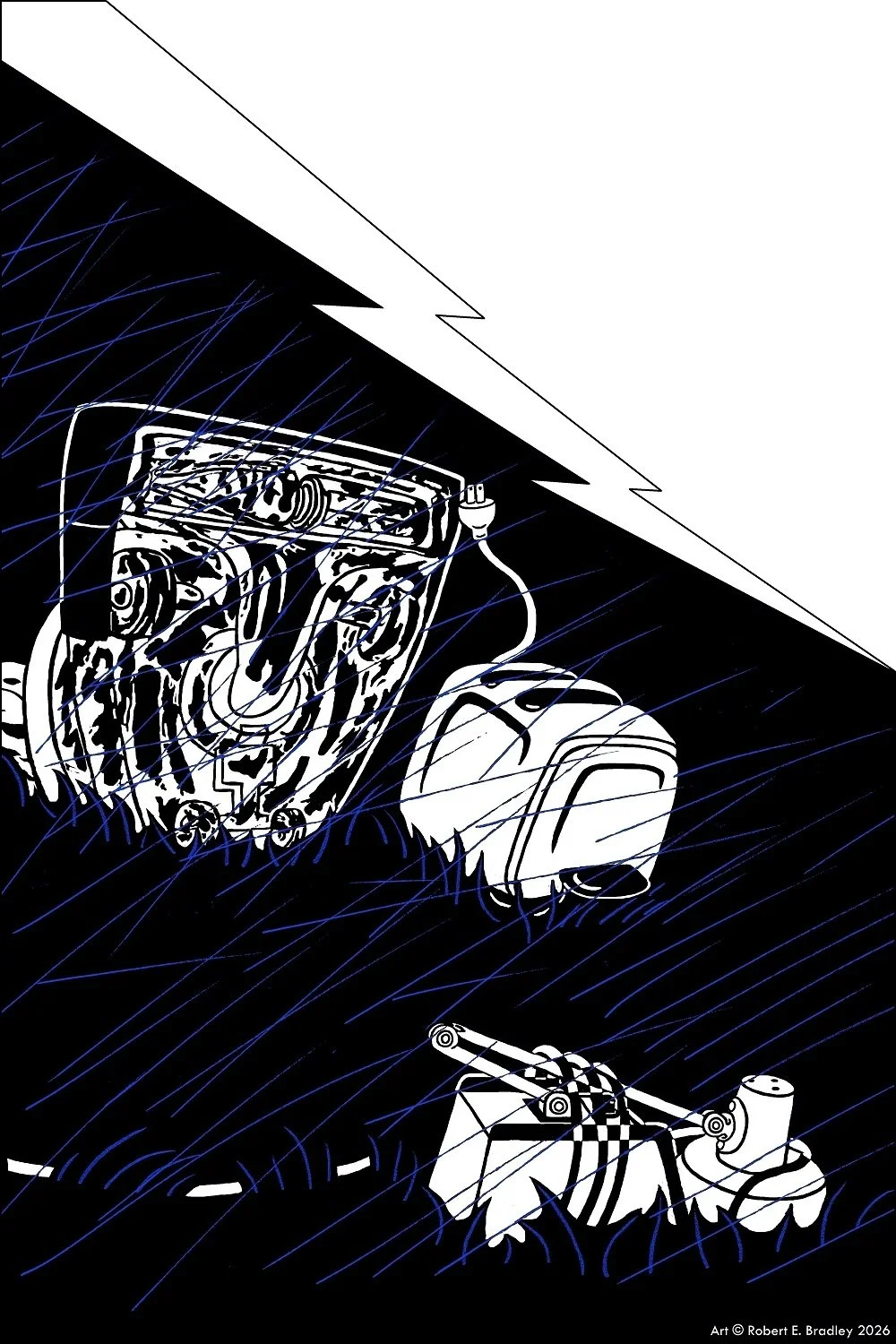
“blurry with static”
The storm is causing interference.(121)
“the toaster assured”
Here, even in an extremely chaotic situation, the toaster continues its role as one who eases tension.
“the toaster suggested”
The toaster does not order, command, demand, nor dictate. It only suggests as to not add further panic in the moment.
“if you were a person”
The idea of shifted perspective is turned on its head here with appliances speculating on what a human being would make of a lightening bolt.
This concept of perspective twisting from the human to the machine and back, becoming something of a confusing pretzel, was utilized in one of Disch’s earliest short stories; The Demi-Urge.
“a berserk giant”
The image of a bolt of lightning also appears in The Vengeance of Here, or Monogamy Triumphant
In On Wings of Song, a character comments on the subject of lightning in a similar way:
“‘Once you’ve seen lightning in the mountains, you can understand why the Greeks put their most important god in charge of it.’”(122)
It is also the power of electricity in the form of shock therapy that cures the protagonist in Displaying the Flag of his initial ailment.
“many times larger than yourself”
Yet another parallel to Wonderland, in his case where Alice finds herself in situations where her being larger or smaller than whoever or whatever she encounters greatly shifts her perception of that object.
“the highest branches of the tree”
The fears of a forever-lost blanket are dispelled.
“as rain will do”
The effects of this are made apparent in the following section.
“stopped working altogether”
An additional allusion to death, in fact the same words applied to the air conditioner.
“waving”
The fears of a no longer working blanket are also dispelled.
“a great rip right through the center of me”
A character suffers a similar wound in Disch’s short story The Apartment Next to the War.
“And I hurt”
Appliances can feel pain, a rather disconcerting detail.
“droplets fell”
As the later sections will attest, the blanket is on a further track of decay compared to the others.
“time”
Even Harold brings it up.
“his assistance”
In The Invisible Woman, the protagonist is saved from a heavy rain by the newsstand seller’s hospitality, inviting her into his apartment.
In After Postville, the notion that everyone in one way or another, physically, mentally, linguistically, etc., disabled is proposed. As one character in that story puts it, “‘It’s a lesson we all get taught in due course, without outside help.’”(123)
“painful process”
What is being affected to cause this pain? Are exposed wires like nerve endings?
“commiserating”
According to Merriam-Webster it means to “feel or express sympathy”.(124)
Disch also used this word in Clara Reeve, Celebrity Love, and The M.D.
“rescue”
Here another Alice parallel appears. In the fifth chapter of Looking-Glass, a strong wind in the form of a massive crow blows the White Queen’s shawl to which Alice catches and delivers to the Queen.(125)
“a fate too terrible”
Another death reference.
The notion of a fate more terrible than death itself is mentioned in The Voyage of the Proteus.
“rain-sodden”
More decay.
“do for you”
An idea Disch scribbled the following on a mostly blank page on the early draft:
“blanket dances, is caught in a raspberry patch the toaster talks with the squirrels + bargains.”(126)
“I don’t know what he means to do, but he seems to”
Here Marjorie reverts back to applying a gender to the toaster.
“I think it’s a trick”
Harold displays a hint of prejudice in his distrust of these beings with an alien appearance and differing outlook on life compared to his own. Two short stories that Disch wrote that gave closer inspection to this theme are Displaying the Flag and After Postville.
In his essay The Third World and Other Alien Nations Disch commented on a similar point:
“I do not mean to suggest that all aliens in SF are to be deciphered as bad guys of other ethnic backgrounds or the opposite sex in disguise. The aliens in movies have tended to come in one or the other of those flavors, usually for demographic and budgetary reasons. Demographically, simple tales of Us and Them appeal to the lowest common denominator. Budgetarily, people in costumes are a whole lot cheaper than any of the available alternatives. And people in costumes (whether with green skin, warts, funny ears, extra eyes, fur, or talons) register as at least multicultural and usually sinister.”(127)
“a crispy brown”
The toaster uses its proverbial magic to turn the nuts to gold.
“when it judged”
After its time making toast, it probably knows when things are at their right level of toasted.
“Marjorie, especially, was insatiable”
Is it possible she and Harold are expecting a family? Speaking of family, in the Rest outline Disch wrote this:
“A family of squirrels will discuss gender and family life with them…”(128)
“remain in the forest as their guest”
The squirrels are so taken by the toaster’s talent that they seem to want to keep it for themselves.
Here another parallel with Looking-Glass appears. When Alice helps to properly dress the White Queen, recommending to her that she “‘should have a lady’s-maid!’” the White Queen eagerly offers Alice the job.(129)
“deep obligation”
Duty is yet another theme Disch visited and revisited frequently. It appears in the short stories Bone of Contention, The Birds, Concepts, The Wandering Jew, The Sightseers, The Pressure of Time, Chanson Pérpetuelle, as well as his novels Clara Reeve, On Wings of Song, The Businessman, A Troll of Surewould Forest, and The Sub.
“but it really isn’t possible”
This is so for two reasons, the first, the appliances obligation to the master. The second, even if it were to accept Harold and Marjorie’s offer, how could the toaster continue to roast nuts without a power source?
“reason for their journey”
This again draws parallels to Wonderland where, in the fifth chapter, Alice explains herself to the Caterpillar all that has happened to her since the start of her adventures up to that point.
“clogged with mud”
It’s as if the Hoover were a person suffering an illness.
“the lamp’s beams”
The sun is the only lamp the squirrels need. Besides, the lamp could do little to protect them from predators out at night.
“the radio’s music”
The symphonies of the forest are all the music Harold and Marjorie need.
“plugged itself into the battery”
This indicates that the Hoover and/or the toaster must have attached a power strip to the battery.
“‘Until,’ she explained, ‘you’re quite well again’”
Marjorie does not understand that, unlike herself, the blanket is incapable of healing from injuries on its own.
“your tail”
How Marjorie perceives an appliances’ cord.
“that black thing”
Marjorie would obviously not know what to compare a car battery, or any battery, to anything she had seen in her life.
“furry part”
She’s more than likely never seen a sheep before and thus would not know what wool is. It’s possible that she would’ve been confused, if not mortified, to know such a fact about the blanket.
“Most agreeable”
The squirrels talk throughout as if they were a well-to-do couple.
“the battery would be worn down”
This marks the first time the prospect of the battery losing all its power is brought up, foreshadowing the next section.
“useful again”
This is the first time in the tale that any of the appliances is renewed to its sense of purpose, being of service to someone. Established here, this will be brought back a second time where it will carry a greater significance.
A character feels a similar way mid plot in The Vengeance of Hera, or Monogamy Triumphant.
“raindrop patterns”
Another sign of decay from the rigors of the journey.
“they were seeing themselves in its sides”
Here is the second incident of the toaster’s chrome catching outside attention. This time the confusion is not merely one of appearance as with the daisy but with the notion of gender identity as well for, as it has been hinted at, the squirrels can only see living beings through the frame of the “’universal law’” that they firmly believe in.
This situation taken from the perspective of science fiction and its tropes relating to extraterrestrial contact, the ones Disch commented on back in the last section, looking for the known in the utterly unknown in an attempt to make the uncomfortable comfortable is made apparent here.
Unlike the daisy who was of a one-track mind in its interaction with the toaster and thus easier to leave, Harold and Marjorie have not only carried on conversations with the whole group but have also assisted in rescuing one of them. Because of this complication, the toaster must find a way to appease both and set their minds at ease so the appliances’ journey to the city can carry on.
In the short story The Vengeance of Hera, or Monogamy Triumphant, one of the characters sees herself in the image of a mother and her children.
In another short story, The Second Coming of the Christ, included in The Word of God, Jesus and Saint Peter depart Heaven to make a visit to Earth and take on fleshly form to interact with humanity. At one point in the story they happen to catch themselves in a reflection:
“‘It’s strange,’ said Peter, ‘but when I look directly at you, I see the Jesus I know. It’s only in the mirror you look like...someone else.’
‘What’s the old saying?’ “O what a gift the Giftie gie us, to see ourselves as others see us.” That’s what mirrors are for, I suppose — so we can see the selves that other people see.’”(130)
In the 1980 version of The Pressure of Time, the protagonist is muddled by her impressions of another character:
“The Walter Lisovski which they were assembling seemed more incomplete than the one she had thought she had known. His essence was diffused though his host of friends, as though each of them bore some pale and distorted reflection of him, which in their addition, each to each, did not quite tally up.”(131)
“unacquainted with the principle of reflectivity”
Returning to the early draft, this sentence immediately followed
“It was all it could do not to burst out laughing before them.”(132)
“appliances have to be rational”
Despite this claim of rationality, appliances are just as susceptible to things such as emotions, bias, and, as displayed by the blanket back in section five in part one, prejudice as the humans that designed and manufactured them.
“true to their promises”
If not, they would figure out the toaster deceived them about its being a man to Harold and a woman to Marjorie, playing “‘a trick’” on them as Harold had put it. This would not make for a good set-up to a reunion, which the toaster probably figures is unlikely to happen.
One character utilizes a similar use of deceit to save someone’s feelings in A Kiss Goodbye.
For the ultimate comment on gender, Disch wrote that “a skeleton is gender-neutral.”(133)