
TITLE
“The Brave Little Toaster”
Disch had considered several titles for the story. They included:
The Totally Electric Family
The All Electric Family
The Live Electric Family
The Electric Orphans(1)
“A Bedtime Story for Small Appliances”
This sets the stage in the reader’s mind for one of the overarching themes of the story, that of perspective, shifting theirs and fitting them into the world of Toaster.
Disch once spoke of how he approached this theme in his work:
“You perceive things differently. Which means that though you can persuade people of a certain attitude if you take them step by step through the process by which you arrived at the view of things, if you assume that attitude and proceed from there to tell the story based on those assumptions, the result is disconcerting. That disconcertion can be experienced either as strange and wonderful or as strange and threatening, depending, I suppose, on whether the reader in his own movement, in creating his own frame of perceptions, is heading in the direction you’ve gone so the lack of sympathy is basically a way of avoiding talking about the issue, the subject matter that the narrative is dealing with.”(2)
A little further on in the same interview, he specified on writing his first outing in children’s literature.
“It’s lovely to be able to move into that frame of mind. The Brave Little Toaster is probably my best sustained adventure in innocence. I think it’s something everybody loves. Usually the difficulty for artists in writing about innocence is that it moves into a kind of Shirley Temple type of sentimentality and cute darling falsifications.(3)
By way of the subtitle, Disch is telling the reader to consider the world in a way they may not have considered before. From there, the worlds of human civilization and of nature become transformed.
POEM
“Lives there a man”
This could be interpreted as the master himself, the source of the five appliances’s devotion and thus the driving motive for the tale to begin. It could also be a representation of humanity as a whole that appliances, as a whole, devote themselves.
“with soul so dead”
The first, and certainly not the last, allusion to death.
In the master, the appliances see their ultimate purpose for existing and what they were created for. In a way the master becomes a savior from destruction and a prolonger of their lives.
From the interpretation of mankind altogether, this line could be seen as how we all, in our day-to-day lives, take for granted the appliance as something quite integral to our routines. When they ain’t broke, why mind them?
“never to his toaster”
In the story there are actually three toasters. This could very well be an amalgamation of all of them, as each would have been as equally devoted to their owner and their task.
“‘years can’t dim’”
An appliance’s devotion never weakens despite the time that passes and as its abilities begin to falter.
“each fresh slice”
Bread, toasted and untoasted, buttered and unbuttered, appear with quite the frequency in the novels, short fiction, and poetry of Disch.
Often it is bread, whether toasted or not, or buttered or not, it is an indicator of the quality of life the characters, who make and consume them, have. The imagery of toasted bread in association with wealth and prosperity occurs in such novels as Clara Reeve, published under the pseudonym Leonie Hargrave, and the Hugo-nominated On Wings of Song.
“‘Not too dark but not too light’”
Or, in other words that will appear later, a golden brown.
In fairy tale fashion, the toaster becomes both the miller’s daughter and the title creature from Rumpelstiltskin, kind natured soul who can also spin straw, or in this case wheat, into gold.
In his book I Want That! the popular culture author Thomas Hine wrote about the miracle of such commodities and how we as humans desire such things. “Objects are useful. They are repositories of magic. They carry meanings that are more powerful than words because they can embody the paradoxes of life.”(4)
“Thomas M. Disch”
The preceding poem did not appear in the original August 1980 issue of The Magazine of Fantasy & Science Fiction. It first appeared in 1986 in the Doubleday/Grafton illustrated edition.
SECTION ONE
“Ooh yeah, I’m gonna fade away”
The Rolling Stones
“By”
The story is divvied across seven “parts” and twenty “sections”.
At the beginning of every “part” in the original 1980 publication, the first letter was made bold and enlarged. This was dropped in the subsequent anthologies it was included in 1981 and 1982 but reinstated in the 1986 edition. When noted, the 2009 MF&SF reprint has slightly altered choices of enlarged text where specific “parts” begin from the original.
The beginning of every “section” was designated with a paragraph break. This was consistent across all the above-mentioned versions. There were no numerical indications. They are given here as a frame of reference to keep the notes better organized.
“the time”
Right from the start, time is immediately called to attention to the reader. It will figure quite heavily from here on out.
Time is in fact a theme that runs rampant in the works of Disch from his first story published in 1962, The Double-Timer, onwards. It is the exception rather than the rule for time as an overt theme to not figure somewhere in his writings.
“the air conditioner”
The first character introduced in the story proper. It is itself a foretelling of where the other five appliances are headed.
When it comes to the choice of an air conditioner to represent the fate that is in store for the main characters, Toaster is not the first case in which Disch would come to use this machine as a representation of decay and as will shortly be discussed briefly, death.
It appeared or was used as imagery, starting with the short story White Fang Goes Dingo, in his novels Camp Concentration, 334, The Sub, his short stories Downtown, The Girl with the Vita-Gel Hair, Palindrome, his novella The Proteus Sails Again, and in his poems September of ’88 and We Are Divided Everywhere in Two Parts. It even showed up in Amnesia, the 1986 text-adventure game he wrote.
There is also a real world parallel that corresponds with Disch’s choice of symbol.
With the ever-growing need for air conditioning from the previous decade, there were over 24 million units in the US by the beginning of the 1970s. “Perhaps,” wrote Gail Cooper. “more than any other appliance, air conditioning systems propelled energy consumption to record highs.”(5)
The 1970 census showed that close to 37 percent of Americans had at least one air conditioner in their home compared to the 13 percent of 1960.(6)
Along with ACs, cooling devices such as refrigerators and freezers contained certain molecules, environmental scientists discovered, that were not influenced by any natural processes on their journey to the atmosphere, making their stay up there range from decades, like CFC-11, to, in the case of CFC-115, beyond a millennium, thus putting Earth on an altered course meteorically.(7)
Soon it was not just the planet that was being directly affected by controllable weather. At the 1976 American Legion convention in Philadelphia, 182 of the attendees came down with symptoms of pneumonia, 29 of those attendees succumbed to their illness. The following year it was figured out that the newly categorized bacteria, Legionella pneumophila (named after the convention), had found their hotbed in the water produced by the building’s air conditioning and had spread via the vents.(8)(9)
Legionella was soon discovered to be found in 40 to 60 percent of air-conditioners all over the world.(10)
It was also possible that the increased cases of obesity from the start of the 70s onwards were influenced in part by the increased use of air conditioning.(11)
For narrative purposes, the ailing air conditioner will serve as an apparition of sorts as it will be brought up several times more over the course of the tale.
“out-of-date”
Another worry that, although the others will not openly admit it, the appliances will be constantly mulling over.
“stop working altogether”
The first reference in the story proper to death. Assuming it was installed in a window, it makes sense that the air conditioner would be the first of the appliances to go with it being the most exposed to the outside elements, especially considering if it had been there ever since it came to live at the cottage as the story had stated.
The theme of death itself, often hand-in-hand with time, is a theme Disch thoroughly, almost obsessively, explored from the start of his writing career till the very end.
Disch also began other stories with the death of a character; the short story The Pressure of Time and the novel Clara Reeve being two examples. Additional instances of death turn up in short stories such as Downtown, The Silver Pillow, The Burial Society, The Invisible Woman, Nights in the Gardens of the Kerhonkson Prison for the Aged and Infirm, and The Shadow.
It was not a mere coincidence that an air conditioner’s appearance in Camp Concentration, a story centered around a group of people being tested with a super intelligence drug which has a side-effect resulting in the degradation and demise of their mind and body, as a symbol of decay and death came about when two events in Disch’s life had occurred during that novel’s creation.
The first was that his mother died. The second was that he had come down with hepatitis which had severely debilitated him.
“I was so dumbfounded by the disease itself that it didn’t register that I was dying. Then the long convalescence, the incapacity of my body to carry on normally, made me intensely aware of my mortality.”(12)
Disch’s ideations on death will be discussed in further detail during section fifteen in part five.
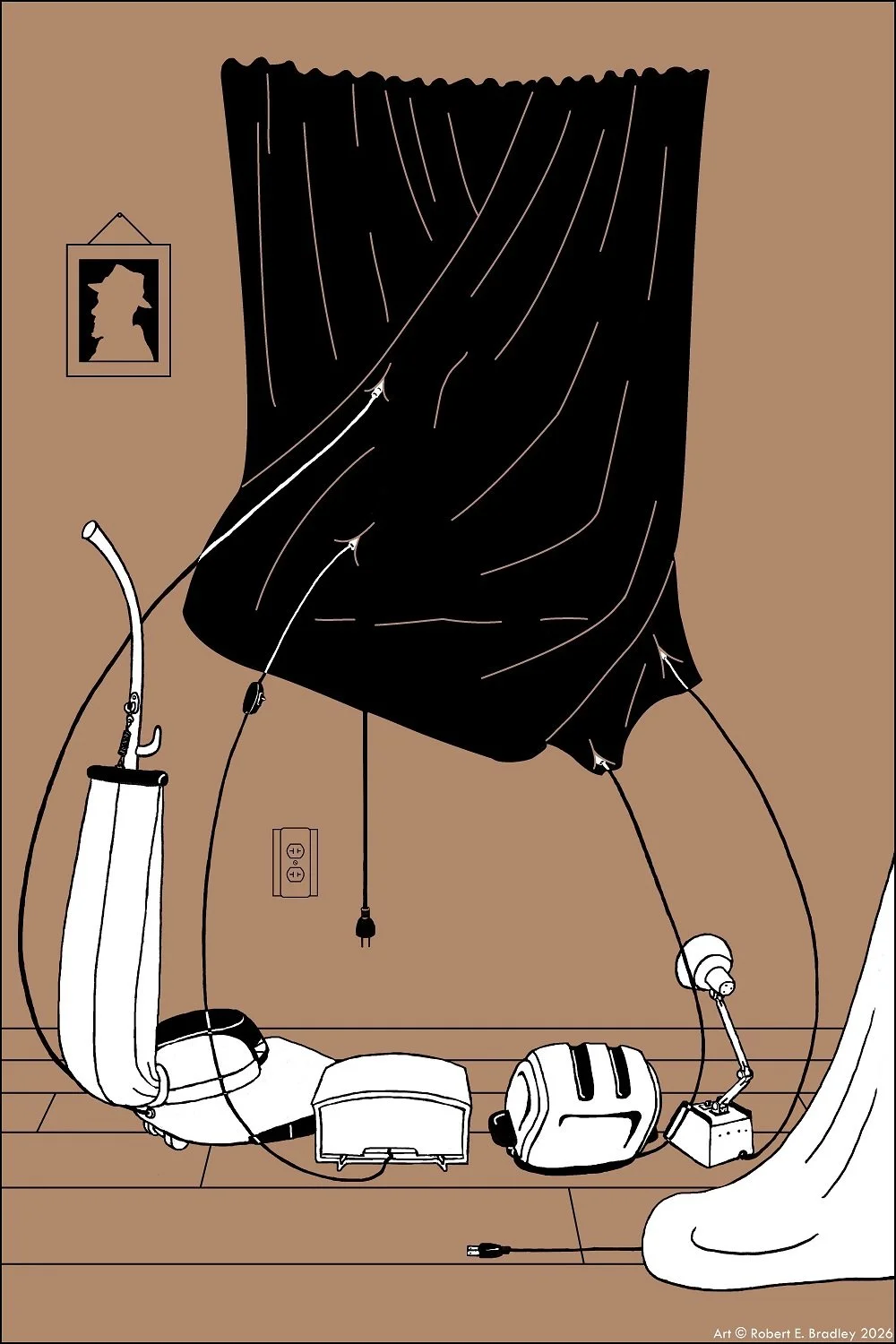
“distinct relief”
This seems the inverse from an observation by Elisabeth Kübler-Ross, to which she wrote about terminally ill hospital patients, once coming to terms with the inevitable, viewing death itself “as a great relief.”(13)
Characters in The Pressure of Time, Clara Reeve, The Silver Pillow and the novel The M.D. also connect with this sentiment following someone’s passing.
“it had never really been friendly”
For something with a very negative perception of itself, this comes off as no surprise.
“never really”
In an early draft of the story, the overall structure and progression of the story was much the same with a few passages either yet to be elaborated upon, changed, or completed omitted. The following is that draft’s version of the opening paragraph:
“The Air Conditioner had never been very strong through all the time they knew it. It had spent its best years in the city, and by the time the air conditioner came out to the summer cottage to be with the other appliances it was already wheezing and whining about feeling old and useless and out-of-date. The other appliances felt sorry for the poor thing, since there is nothing so sad for any appliance as feeling useless, but when the air conditioner finally did stop working altogether, they also felt a certain relief. In all its time at the cottage it had never really been friendly with the little clan as they called themselves.”(14)
Something to note is that Disch later reworked a similar phrase from this paragraph into The Brave Little Toaster Goes to Mars, ending a paragraph in that story with the sentence “Nothing hurts so much as feeling unused.”(15)
“being the oldest”
In the sequel, the vacuum cleaner is specified to having been made in 1940.(16)
“it was a Hoover”
The vacuum cleaner, for the majority of the story, will be referred to by its brand.
The imagery of vacuums appear in such Disch short stories as Touring Mr. Amberwell, Palindrome, and his novella The Proteus Sails Again.
Disch also utilized the Hoover brand in his novel A Troll of Surewould Forest.
“off-white plastic alarm clock/radio”
Here, three details about this particular appliance are established. The first and third are expository. Assuming its color is not the color it was given by its manufacturer, the radio being off-white is an indicator of its age.
For most of the story it will be referred to as the radio while its alarm and clock functions are seen as secondary to its ability to receive airwaves.
Due to its ability to tell the time, in conjunction with receiving programs such as the news, it is able to put into perspective for the other appliances, those both partaking inside and reading outside story, how long they have been in the cottage.
The second seemingly minute detail, its being made of plastic, will figure significantly into the plot later on.
Disch credited the medium of radio as the ultimate source of his creative spirit:
“So the story of how I came to write The Brave Little Toaster and so many other books is a history of my pretending, and that history begins at 10 A.M. on Saturday mornings beside the radio in our sun porch (which was also my bedroom) at 4104 Bryant Avenue South, in Minneapolis. That was when they broadcast the radio program Let’s Pretend, with a different fairy tale dramatized each week. I would stare into the green light above the radio dial, which looked exactly like a large cat’s eye, and watch the program on the video screen of my imagination.’”(17)
An alarm clock/radio is also to be found in Disch’s short story Death Before Dishonor and the color of off-white in Downtown.
“cheerful yellow electric blanket”
Of the five appliances introduced here, the blanket alone is given a purely emotional descriptor. Once again, this is not a throwaway decorative choice on the part of Disch. More so than any of the others, the blanket will go through a dramatically emotional, as well as physical, transformation.
In the early draft the blanket was given the detail of “a single black stripe along the top.”(18)
The color yellow seemed to have some significance for Disch as it appeared, in various shades, in short stories like The Empty Room, The Girl with the Vita-Gel Hair, Palindrome, Celebrity Love, After Postville, and his novella The Proteus Sails Again.
“tensor lamp”
In the versions published in 1980, 1981, 1982 and 2009 the word “tensor” was never capitalized unlike the word “Hoover” despite it also being a brand name. In the 1986 book edition it was capitalized. Then the word reverted back to being not capitalized in The Brave Little Toaster Goes to Mars published in 1988.
It is possible that Disch wrote it that way either due to the “t” in the brand’s logo being lowercase or because the lamp is actually an off-brand tensor.
A tensor lamp also made an appearance in the novel The M.D.
“a savings bank”
Disch wrote in passing of having, during the early phase of his writing career, a job at a savings bank in the Flatbush part of Brooklyn in New York City.(19)
“a bright little Sunbeam”
A one-two punch description to which the toaster will live up to in spades, being a beam of bright sunlight that will drive the narrative forward.
Unlike the vacuum, the toaster remains referred to as the toaster. The word Sunbeam will only return a second time towards the end of the tale.
Now, the use of the toaster as an image was not a new one for Disch to his creative endeavors. In fact, it can be knowingly traced as far back as the early days of his career as an author.
The first known work of fiction where this appliance appears is the short story White Fang Goes Dingo, published in 1965 and later expanded into the novel The Puppies of Terra. He had begun writing the earlier version of the story shortly after completing his first ever successfully sold story, the previously mentioned The Double-Timer, in 1962, with an initial version completed, according to Robert Thurston, that August.(20)
The plot of White Fang concerns the titular protagonist, a human living in a post-alien invasion Earth where superior intelligent life forms, simply referred to as “The Masters”, have made humanity their pets. At one point, White Fang is accidently left behind by his master. Though he cannot actually see his owner he can sense their presence and describes them and their subsequent absence thusly:
“It was like a house that’s been drawing too heavily on its current. Everything was turned on: the refrigerator, the stove, the air conditioner, the iron, the toaster, the coffee pot, the flood lights, the television, and the model railroad in the basement. Then Blat!, lightening strikes and there’s one hell of a short circuit. Lights out, tubes popped, wires burnt, motors dead.
“The Masters weren’t dead, of course. They’re made of stronger stuff than toasters.”(21)
A toaster was to turn up again in 1967 in the short story The Contest and again in 1975 in The Joycelin Shrager Story where it is one of several objects mentioned being left behind during a move to an apartment by the protagonist of that story.
As to the genesis of the novella of The Brave Little Toaster itself it is via a letter correspondence between Disch and another author that its origin point is revealed.
In 1975, five years prior to the MF&SF featuring Toaster, John Goldthwaite, under the pen name Kaye Saari, had his picture book The Kidnapping of the Coffee Pot published. In October of 1981, Goldthwaite, having become aware of the latter’s story, wrote to Disch inquiring whether or not Coffee Pot was an influence on Toaster.
In reply, Disch wrote:
“I’m sorry (or should it be happy?) to say that your book had never come to my attention during the time I was writing The Brave Little Toaster. I began it in early ’76, but the idea had been in my files for a while longer--the idea, namely, of anthropomorphizing electric appliances and using them in a story that took the form of an animal fable, in particular The Bremen Town Musicians. Where that idea came from, in turn, is my domestic fantasy life: liking pets, but being a frequent traveler, I and my roommate and sometime collaborator Charles Naylor have developed personalities for various ‘beings’ about the apartment. Our toaster, naturally, lays claim to being the inspiration for the story. Though he’s never made such a heroic quest himself, his personality undoubtedly lies behind the portrait of the Toaster in my story,” To which he ends the letter “my best regards to your coffee pot. (It is electric, yes?) My toaster sends his warm regards.”(22) Coincidently, alongside a toaster in both cases, a coffee pot is among the objects listed in the earlier quote from White Fang as well as one of the objects left behind in The Joycelin Shrager Story.
In Disch’s novel The Businessman: A Tale of Terror published three years after the above correspondence (which also features an appearance of a toaster), in a possible nod to this interaction, a coffee pot is described as something “that could be counted as a friend.”(23) A coffee pot later appeared in the short story Voices of the Kill in 1988.
Now, there is a bit of a discrepancy as to what year Disch began writing Toaster proper for in his 1986 autobiography, he claims there that he wrote the story in 1978, contradicting his earlier claim to Goldthwaite.(24) The strongest piece of evidence that points to 1976 being the correct year is the fact that the earliest known contract for the story is dated to the year 1977, with a subsequent rejection letter from that would be publisher dated September 20 of that year. This indicates that the story had to have already been written prior to his submitting the manuscript.(25)
The specific toaster Disch is referring to in 1981 was one he had purchased, he claimed in an interview for the Canadian Press published April 11, 1986, sometime in 1971.(26)
In another interview, for the May 11, 1986 issue of Book World, Disch spoke fondly of it:
“I have a very happy relationship with my toaster. Every morning it’s there, bright as [a] button, ready to please me and work for me. What more can you ask?”(27)
Even after its sequel in Mars, toasters continued to appear here and there such as in his poems Garage Sale and Inventory, and even in the TV Miami Vice episode Missing Hours for which he wrote the screenplay.
It is evident, with his continued use of the toaster as an image and the above comments he made about his own, as well as the depiction of breakfast scenes and toast-making of some type in other stories, that Disch held positive emotions in this often warm, chrome-plated little kitchen companion; that fondness being culminated here in The Brave Little Toaster.
“It was the youngest”
It’s implied, with the Hoover designated the eldest and the toaster as the youngest, that the three between them, the radio, blanket, and lamp, are the second, third, and fourth oldest, respectively.
Also, in The Brave Little Toaster Goes to Mars, the appliances besides the Hoover are said to have been made in either the 1950s or 1960s.(28)
Another observation of note is that often in fairy tales the youngest member of the family tends to be the protagonist of the story.
“the master”
The first mention of the appliances’s owner in the story itself, who they see as their father/king/god figure, their reason for being and whom they serve unquestioningly.
“the city”
The mid-twentieth century American equivalent of a fairy tale’s castle or kingdom.
“years and years and years ago”
The master has been, in the case of the elder four, their owner for so long that, as will be stated in the next section, they have developed a particular attachment.
SECTION TWO
“There doesn’t seem to be anyone around”
Tommy James & the Shondells
“It was a pleasant cottage”
Note Disch’s use of the word cottage, a building that is often the starting point of many a fairy tale.
Disch had previously utilized a cottage in his short story His Own Kind and would use it again in both of the novels The Businessman and The Sub. In the latter, a description of what that cottage’s interior looks like is given, “a typical backwoods bachelor pad: a single open space with separate areas for sleeping, watching TV, cooking, and eating. Spartan but a cut above plain trash.”(29)
The cottage in Toaster seems not too far in resemblance to this description.
“so far from the nearest highway”
Disch also utilized the setting of a house far away and isolated from civilization in the short story Voices of the Kill.
“the reassuring sounds”
It’s as if the cottage is a mother of sorts, speaking words of comfort to them as it shelters and protects them from the outside world.
“countrified ways”
It appears Disch’s childhood was an inspiration for this rural setting and the positive feelings that surround it. In his autobiography he wrote:
“My mother’s people were subsistence farmers in the Mille Lacs area of central Minnesota. Their lives and land were poor enough that they could fairly be called peasants.
“…[M]y Gilbertson grandparents decided the farm was too much for them, and so for five months I was to live in that hand-me-down Eden. The raspberry bushes, flower beds, the senile orchards, the sagging barn and haunted chicken coop, the icehouse with the woodpile stacked against it, the bats in the attic, the wrens in the birdhouse, the snakes in the grass: the wood range in the kitchen, the grates in the floors of the upstairs bedrooms, which were their only source of heat (and a wonderful way to eavesdrop on the grownups): no other place in my childhood remains so distinct in memory or so dear as that house, the fields and woods and swamps about it, the great reedy lake just down the road. We Disches enjoyed that borrowed splendor for the summer and fall of 1948.”(30)
In his essay My Life as a Child he elaborated further:
“For one beautiful summer and fall when I was eight years old, my grandparents moved off their farm and we moved in—my Mom and Dad and me and my three-year-old twin brothers, Greg and Jeff. It was like moving backwards in time. There was no electricity, no running water, no bathtub or indoor toilet. My mother cooked, as Grandma Gilbertson always had, on a wood-burning stove. We got our water from a pump located a good long carry from the house. There was a small icehouse behind the farmhouse filled with great blocks of ice cut from the nearby lake when it froze over during the winter and that’s how things were kept cold. There was a root cellar under the kitchen for keeping things like potatoes and apples, and shelves and shelves of Mason jars filled with the fruits and vegetables from our own enormous garden.
“I was old enough to help with all the basic chores, pumping and carrying water, bringing in wood from the woodpile that was stacked alongside the icehouse to keep it cool in the summer, weeding the garden, feeding the rabbits in the hutch. But they didn’t really seem like chores. It was all a great adventure, a nonstop camping trip, a summer vacation in the Garden of Eden. Beyond our garden were orchards and pastures and beyond those were woods and swamplands that I could explore all summer long. Only once did I get lost and have to be returned home by neighbors whose farm I’d found my way miles away from where I’d started out.”(31)
These memories left him with wanting more for he later rented a cabin in the Poconos Mountains at the age of 43 and hoped someday to purchase a farmhouse of his own:
“The one big difference, of course, is that I wouldn’t try to get along without electricity. I can’t imagine not starting off the day with a slice of toast, and for toast you need a toaster, and toaster’s need electricity.”(32)
Disch referred to his maternal family’s name in both the final novel published in his lifetime, The Word of God and his posthumously printed novella The Proteus Sails Again.
He also memorialized the name in the short story A Kiss Goodbye where one of the characters relates working for a summer on a farm owned by someone of that name.
The name also turned up in the short stories The New Me and in another Toaster-style yarn, The Happy Turnip, where the family of that name owns the farm the protagonist is grown from.
The theme of contented comfort in isolation also appears in the short stories Voices of the Kill, The Invisible Woman, and The Shadow.
“taken back to the city every year on Labor day”
The holiday of Labor day thematically rhymes with the purpose of the appliances.
Holidays in general are another thing Disch played with throughout his career, usually as markers of the passing time.
Labor day is also mentioned in Voices of the Kill.
In addition, the image of seasonal migration appears in several Disch stories, among them The Birds, Voices of the Kill, and Celebrity Love. A character moving to a city is another common action in stories such as The Invisible Woman, After Postville, and The Shadow.
“the blender”
A blender is made a significant plot point in Disch’s short story Torturing Mr. Amberwell as well as making an appearance in The M.D.
“the tv”
An appliance that is omni-present in the lives of most of Disch’s characters. For examples of TVs being made the greater focus there is, in Disch’s poetry, Bourgeois Idyll, Haikus of a Pillow by Mother, and as the answer to the one of a series of five poems entitled Riddles.
“the water pic”
More than likely the appliance referred to here is one that concerns an oral hygiene care, patented in 1968 by one John W. Mattingly.(33)
“devoted to their master”
Despite their cold comfort in the cottage, the pangs of their designed purpose still call out to them.
Devotion and loyalty also make their mark in other Disch short stories such as Voices of the Kill and The Late Movie.
“from a mail-order house”
In the early draft the toaster’s origin was described as having been purchased “from a suburban shopping mall.”(34)
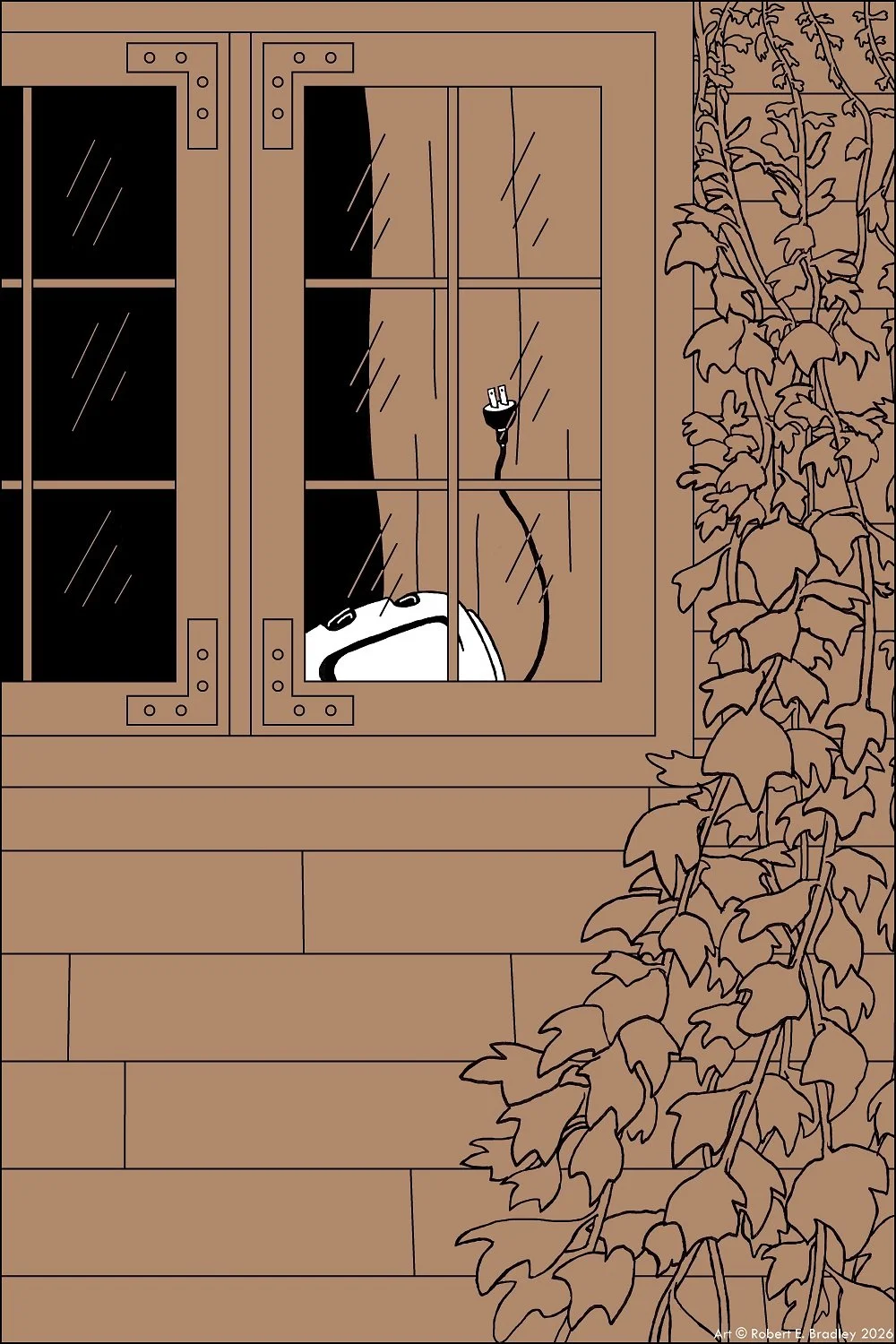
“more curious about urban life”
With the toaster being shipped to the cottage directly and having never lived in the city, this means it must have been ordered the last summer the master stayed at the cottage. This also serves to relate the toaster to the reader who has as much knowledge about the life of the master in the city as the toaster does.
Here again Disch’s life served as the inspiration for the toaster’s curiosity:
“New York City had been the land of my heart’s desire since at least sophomore year, when I had confided to Mr. Hall, the one friendly teacher I’d had in Cretin [a Catholic military high school, named after a former bishop of St. Paul], that I would be going there as soon as I was graduated from high school, if not before. I did resist departing from Minnesota without a high school diploma, but as soon as I had that in hand, and some money saved from a summer job as a structural steel draftsman, I got to New York by tagging along with my three best friends from the Andahaz school, Alan Iverson, Kay Wilson, and Judy Anderson.”(35)
The protagonists of Disch’s short story The Pressure of Time and novels The Genocides, Clara Reeve, and On Wings of Song share similar thoughts on city life. The opposite feeling is the case with the protagonist in The Shadow when her son moves away to one.
“it couldn’t have made more perfect toast”
The innate self-confidence of the toaster in its abilities stands in immediate contrast to the others as will be shortly demonstrated.
“crunchy golden brown”
On the back of the third page of the early draft a fragment of a sentence is typed and written. It reads:
“the completed toast up with a brisk, crisp salute to its master’s appetite, as though to say: ‘Hey, why not have another! Eat up!’”(36)
“the new breeds of vacuums”
The Hoover must have caught sight of commercials the tv was showing, heard ads from the radio, or saw them in a catalog or magazine.
“The blanket felt it needed a dry cleaning”
There are two known preliminary outlines Disch wrote of Toaster that appear to predate the already quoted early draft. One initially titled The Totally Electric Family and another titled Concerning the Rest of the Tale. The Family outline appears to be the earlier conceived outline due to it having significant details less resembling the final story compared to the Rest outline. A key example to start with being that in the Family outline the blanket was originally conceived as a heating iron.(37)
“twinge of envy”
Bulb envy you might say? Regardless, lamps of Jay Monroe’s Tensor design were not intended to illuminate a broad area but to focus in on details like the small print of a book.(38)
SECTION THREE
“I wait in the darkness of my lonely room”
Freda Payne
“abandoned”
Abandonment is a persistent theme that appeared early on in Disch’s writings. It figures in varying forms in short stories such as Come to Venus Melancholy, The Number You Have Reached, Chanson Péretuelle, Downtown, Voices of the Kill, Egg and Chips, The Invisible Woman, The Shadow, the novella The Voyage of the Proteus, his novels The Puppies of Terra, Camp Concentration, Clara Reeve, On Wings of Song, A Troll of Surewould Forest, The Word of God, and in poems like Symphonic Ode for St. Cecilia’s Day, To an Elder Brother, Aborted, Old Friends, and i who have gone through the whole gamut.
The imagery of objects being left behind, as was mentioned in section one, appeared in his short story The Joyce Schrager Story but also in his novel The Sub.
“‘Without an explanation’”
Often, in Disch’s works, the theme of abandonment was followed by a lack of an explanation for the abandonment for both the protagonist and the reader.
Even when abandonment was not a part of the story, the lack of an explanation would befall the characters in his stories when they found themselves in a situation either impossible or sudden such as in his short stories Descending, The Squirrel Cage, Let Us Hasten to the Gate of Ivory, and Palindrome.
In Downtown, the protagonist is described as fleeing her situation without an explanation to her co-workers.
“now so melancholy”
The blanket’s personality seemed to match the toaster’s, possibly even exceeded it. An explanation for this noticeable decline in its spirits is to arrive a little later in the following section.
“‘25th of September, 1973’”
Earlier, it was claimed that the older four appliances were taken “to the city every year on Labor Day.” What is odd is that the 25th of September was not the day Labor Day fell on in 1973. It was, in fact, the 3rd of September.
“‘Today is March 8, 1976’”
An exact time frame is finally given as to how long since the appliances last saw their master.
Also, if the main action of the story taking place in 1976 is an allusion to the year he wrote it, is it possible that the year 1973 might be the year he came up with the idea and/or wrote the first of one of the two already mentioned outlines?
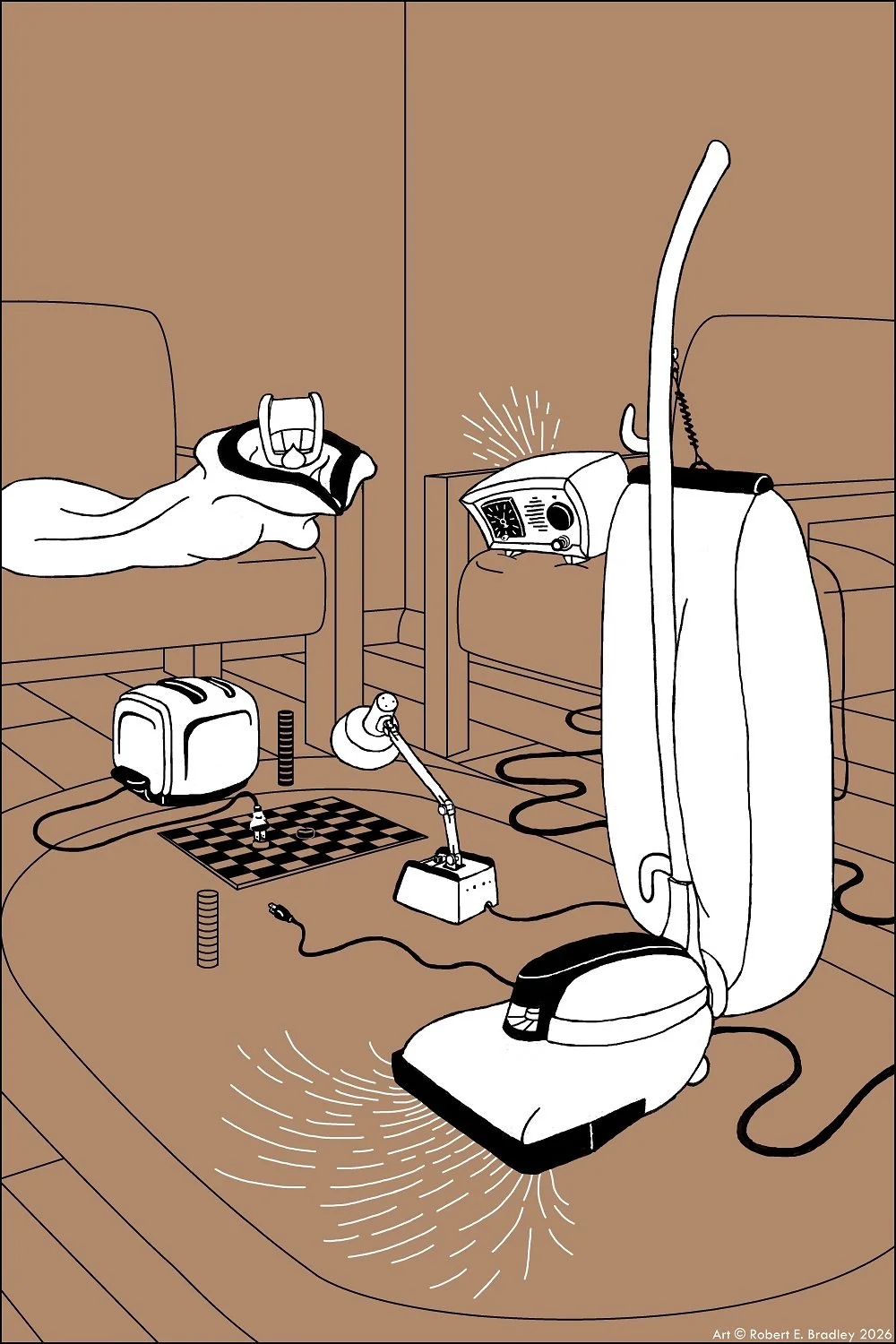
“‘to rust’”
The third reference to death.
“never have dealt with them so uncaringly”
Despite their forthright denial, they know a bit more of the master’s general character than they care to admit. This information will be noted of when it appears in section eleven in part four.
In terms of historic events that occurred that could have influenced this part of the story, the Watergate scandal during the Election of 1972, culminating in the resignation of then President Richard Nixon in 1974, and the national, and international, reaction to those events comes to mind. The sense of collective shock that was felt, that the notion that someone citizens should look up to, elected officials, even the President of the United States, could have ulterior motives that do not concern the people they claim, in their public appearances and speeches, to serve.
From this vantage point, the story of The Brave Little Toaster could be seen as a metaphor of sorts to the decade of the 1970s with its similar concerns about normalcy, leadership, purpose, disillusionment, and others, which will be discussed further throughout these notes.
“an accident, an emergency”
The Shadow also begins with the protagonist living alone in and seldom leaving her house. In her case it has been since her husband had died in a car accident.
“‘must just be patient’”
The imagery of objects being described as awaiting their owner(s) return also appears in The Burial Society.
“‘as though nothing unusual has happened’”
This is yet another action/reaction that characters in Disch’s fiction find themselves doing for one reason or another.
SECTION FOUR
“Maybe it’s worth imagining”
Frankie Valli & The Four Seasons
“all through that spring and summer”
As was established in the previous, and what will be divulged in the following, this section covers the months from early March to late July 1976.
“each morning at seven-thirty”
According to The Brave Little Toaster Goes to Mars, the toaster usually wakes up at 7 A.M., a half an hour before the radio’s alarm.(39)
“imaginary”
There are other instances in Disch’s short fiction in which the idea of a character having to imagine, or believes to be imagining, something occurs. Those stories included The Number You Have Reached, Xmas, and the 1980 expanded version of The Pressure of Time.
“under a broiler”
A broiler could be one of two things. Something built into a gas oven or as a separate tabletop appliance.
A broiler made an appearance in Disch’s short story 5 Eggs.
“an old-fashioned gas ring”
A stove powered by a gas line.
“if it were a Tuesday or a Friday”
These must have been the particular days the master would have taken out the Hoover to clean up the cottage.
The theme of routine and the forming of habits take on a more sinister role in Disch’s short stories The Beginning of April or the End of March and The Silver Pillow.
“would trundle outdoors”
The first time in the story where any of the appliances go outside.
“talking or listening”
On one page of the early draft, these handwritten notes are scribbled:
“The radio argues politics
“The Hoover had been a Nixon supporter.”(40)
That latter note lends credence to the comparison of the Hoover’s outright belief declared in the previous section that their master would have nothing but the appliances best interests at heart paralleling the faith many Americans had in President Nixon leading up to Watergate.
“turn themselves off”
The appliance’s way of going to sleep.
“If only he’d been there”
First, a minor detail, the material the blanket is made of, wool, is revealed.
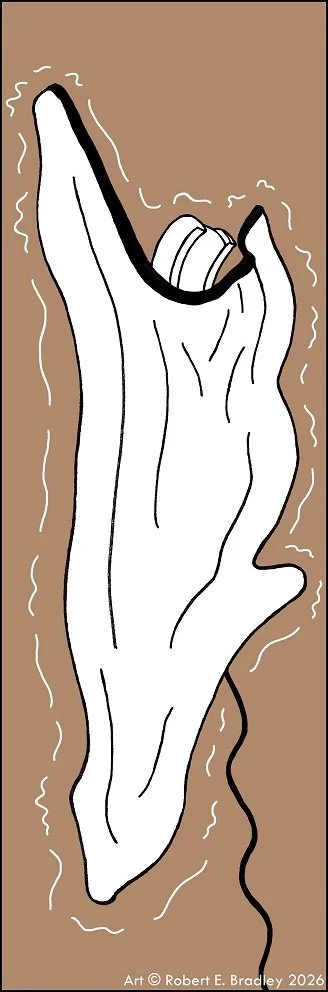
Second, a major detail, this desire to keep the master warm serves as the explanation for the blanket’s melancholy. Unlike the others who can pretend to be useful to a certain extent, being an appliance that requires intimate contact with a living being in order to fulfill its function, the blanket simply cannot pretend. This means it has nothing to do from day to day and thus it makes logical sense it would feel the master’s absence the hardest.
SECTION FIVE
“I soon found out that my lonely life wasn’t so pretty”
The Beach Boys
“At”
In the story’s reprinting in the April/May 2009 issue of The Magazine of Fantasy & Science Fiction, the first letter of this section, not the following one as was seen in the previous editions, is enlarged, denoting it as the beginning of the second part.
“wear thin”
In the early draft, this part of the sentence originally went like this:
“…toward the end of July, when the pollen count had reached its high-point for the year…”(41)
Had it been left in the final manuscript, it would have served as clue as to why the master has not returned since 1973.
“’can’t go on like this’”
The first barrier of denial falls when the pretense of pretending everything is as it was when the master was around, in short maintaining normalcy, becomes impossible for them to keep up.
A character in the Disch’s short story Dangerous Flags utters a similar phrase as the toaster.
The protagonists in the short stories The Empty Room and Downtown also share a similar sense of a lost sense of purpose to life and realizing the futile nature of their attempts at maintaining a sunny disposition.
“‘Soon, one by one, we’ll all wear out’”
In the short story The Number You Have Reached the automatic processes that keep the city functioning fail the longer humanity remained absent.
“‘like the poor air conditioner’”
The second mentioning of the fallen appliance.
“never shown much fellow feeling for the air conditioner or any other appliances whose function was to make things cooler”
The diametrically opposing functions of the air conditioner and the electric blanket are brought up as if they were people with different outlooks on life or with different religious or political beliefs.
In fact, in the early draft the blanket is described as having “always felt a certain disdain for air conditioners and refrigerators.”(42)
Speaking of which: refrigerators and freezers are another pair of appliances that figure in several of Disch’s works often symbolizing the themes of decay and death along with air conditioners. They include his short stories The Sightseers, Three Points on the Demographic Curve, Things Lost, Chanson Pérpetuelle, The Girl with the Vita-Gel Hair, Rude Awakening, The Silver Pillow, Voices of the Kill, The Burial Society, the poem Hands and Mouth, the novels On Wings of Song, The Businessman, The M.D., A Troll of Surewould Forest, The Priest, and The Sub, and the novellas The Proteus Sails Again as well as The Brave Little Toaster Goes to Mars.
One reason Disch might have associated death with these appliances could be the element of the cold that is often associated with death. In The Word of God he reflects upon turning 65 years old, quickly following with “feeling the chill of death...”(43)
Another possible explanation to his association of cold-producing appliances with death could be that, considering his observation of the crippling effects of his bout with hepatitis quoted in section one, they also tend to be large, heavy, and if they need to be moved, a lot of effort, sometimes even a group, must take them away, mirroring the image of pallbearers carrying a casket.
“a dismal, staticky groan”
With the radio’s not so happy reaction to being reminded of its outdated components it is confirmed to use vacuum tubes instead of transistors. This means it had to have been made no later than 1962.(44)
“‘telephone the master’”
Obviously, the most direct way to reach their master.
Telephones are a significant symbol in Disch’s body of work. They often figure as a signifier of great change in a character’s life. They also sometimes, when they cannot be used, as will be revealed here, served as a metaphoric locked door.
They appear in short stories such as The Number You Have Reached, The Beginning of April or the End of March, A Kiss Goodbye, X-mas, Voices of the Kill, Celebrity Love, The Burial Society, The Invisible Woman, The Late Movie, The Shadow, the novella The Proteus Sails Again, along with novels such as On Wings of Song, A Troll of Surewould Forest, and The Word of God.
So much did it hold significance with him that he even dedicated a poem to one fittingly titled The Telephone.
“‘Two years, ten months, and three days, to be exact’”
Assuming the telephone was disconnected the day the master left, that makes the date here July 28, 1976, which lines up with the earlier statement about the time of the month at the start of this section.
The passage of time, more specifically the precise measurement of passing time, is often brought up in Disch’s works: the novels Clara Reeve, The M.D., The Priest, The Sub, and short stories Come to Venus Melancholy, Death Before Dishonor, The Number You Have Reached, The Sightseers, A Kiss Goodbye, and Palindrome being among a selection of examples.
In the cases of Death Before Dishonor, The Number You Have Reached, and The Contest the exactness is down to the very second.
“‘find the master ourselves’”
Quite a radical idea but it is the logical conclusion to their current problem.
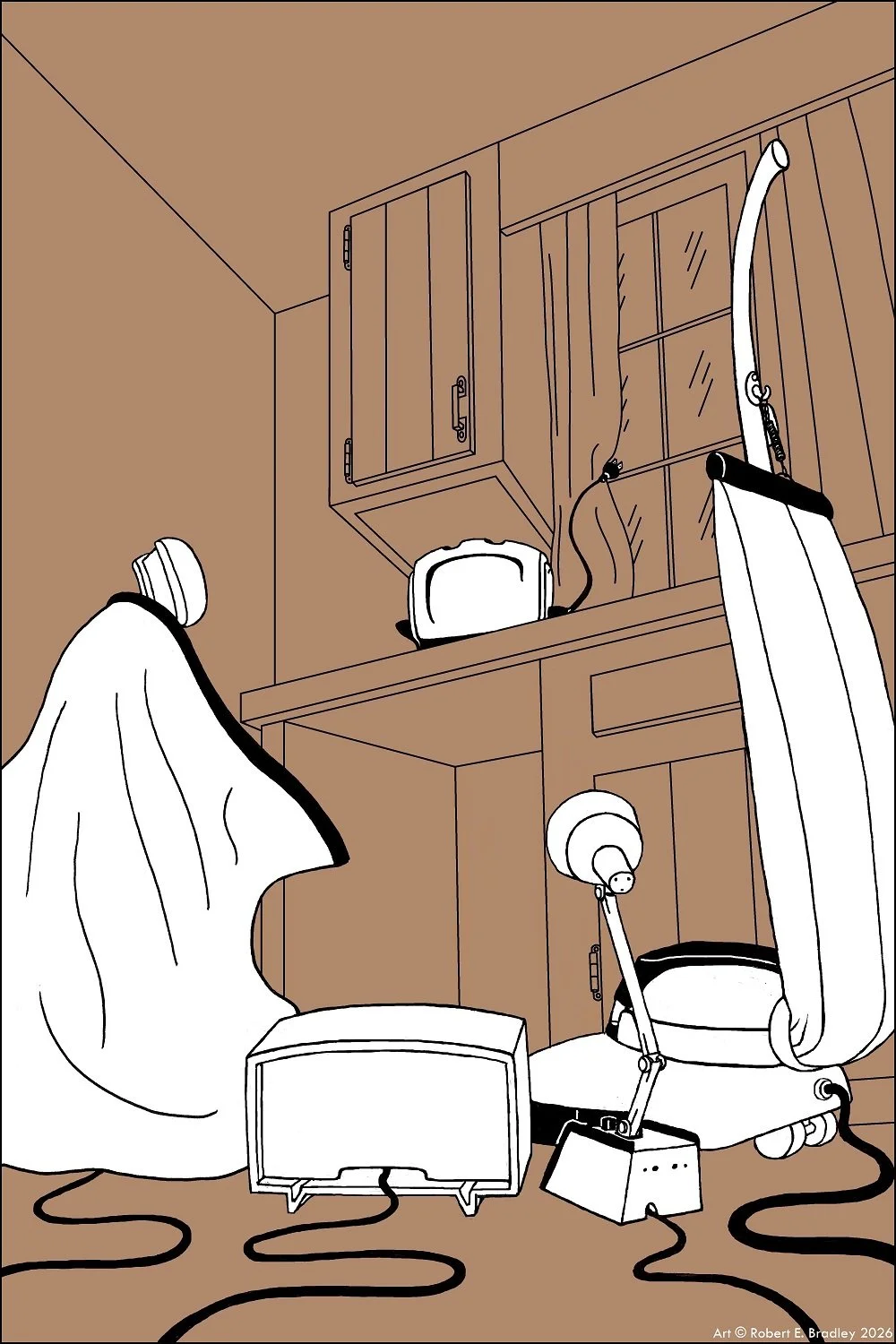
“‘terrier’”
Back in section one, Disch mentioned one direct influence on Toaster, that being the Brothers Grimm fairytale The Bremen Town Musicians. This is not the only source that Disch took into account.
Here, though it is possibly unconscious, this marks the first parallel with Charles Dodgson’s (aka Lewis Carroll’s) books Alice’s Adventures in Wonderland and Through the Looking-glass and What Alice Found There.
Disch himself acknowledged the connection between Toaster and Carroll’s Alice:
“His Alice, like my toaster, had adventures in a world that is just like the world we’re used to—with just one or two small differences such as that animals and flowers are able to talk.”(45)
For this particular instance, in Wonderland Alice also refers to a terrier she knew, declaring its admirable abilities, to a mouse as she swims about the pool of tears.(46)
This will not be the only parallel to the Alice books to go noticed in this tale as will be pointed out as it unfolds.
Disch also features a terrier in his novel The Businessman.
“‘don’t be a wet blanket’”
A foreshadowing of sorts.
Also, in On Wings of Song the protagonist is also described as one.
“feelings were therefore easily hurt”
This is very much in line for the blanket to be emotionally sensitive.
Also, on the same page of the early draft with the earlier mentioned scribbled notes pointed out in the last section are the following typed fragments:
“and the blanket had a kind of understanding that allowed this special kind of free-and-easy banter. The toaster would never had dared to talk to the Hoover in the same familiar tone”
“them to make little jokes with each other. Generally, appliances are rather unimaginative, and their feelings are easily hurt”(47)
“the toaster should make a formal apology”
An example, one of many, of the toaster’s innate ability to smooth things over even if, as here, it was not necessarily at fault.
“declared the toaster”
In the early draft this sentence went:
“’Absolutely!’ The toaster popped its spring with such enthusiasm that if there’d been toast inside it would have shot both slices all the way across the room.”(48)
“turned itself off”
A bit of a confused use of the phrase compared to its previous use.
“‘our wheels’”
Speaking of wheels, much like the way cars were sold, Hoovers were once sold via the dealership model by giving a potential customer a trial period of ten days to let them decide if the vacuum cleaner was worth the then high cost of purchase.(49)
“in a fretful state”
Again, the blanket displays its emotional state on its sleeve, or wool in this case.
“sweet, unswervable logic”
The rest of the story will show this is the toaster’s single greatest trait, besides its being brave, becoming the glue that will hold the group together through the most difficult times as well as being the primary problem solver.
“‘carriage’”
The use of this word invokes, as Disch intended, the aura of fairy tales like that of Cinderella.
“‘will you be able to’”
In the early draft, this passage follows:
“The old Hoover looked doubtful. ‘I’m not sure I understand. Who is going to draw this carriage?’ That was a rhetorical question. Of course, the vacuum understood quite well what the toaster had had in mind. This was just its way of volunteering.
“’I might be able to do that,’ the blanket conceded grudgingly.”(50)