
SECTION SIX
“Oh, yeah, searchin', my goodness”
The Coasters
“serviceable set of wheels”
The search for an appropriate mode of transportation is the first of several problems the main characters must solve in order to achieve their desired goal.
In the early draft the sixth section starts thus:
“And that is what they did, though not without a great many more discussions and one or two false starts. The difficulty lay in finding the right kind of wheels.”(51)
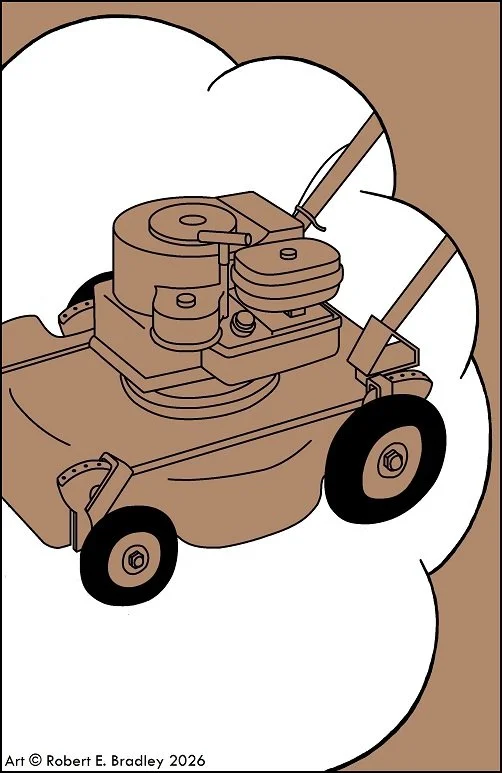
“the lawn-mower”
Here, it is established that things that are primarily mechanical and/or run on gas, or on something not electrical, are not alive unlike the appliances.
“now full of the spirit of adventure”
The blanket is just as absorbed by positive emotions as well as negative ones. Also, that it, along with the other three, are willing to assist in the toaster’s problem solving, establishing teamwork among them all despite misgivings that will crop up.
“rule out that notion”
Despite suggestions for solutions to problems, the other appliances usually do not come up with a definitive one. However, often a failed suggestion might factor in solving the puzzle, as will be seen shortly.
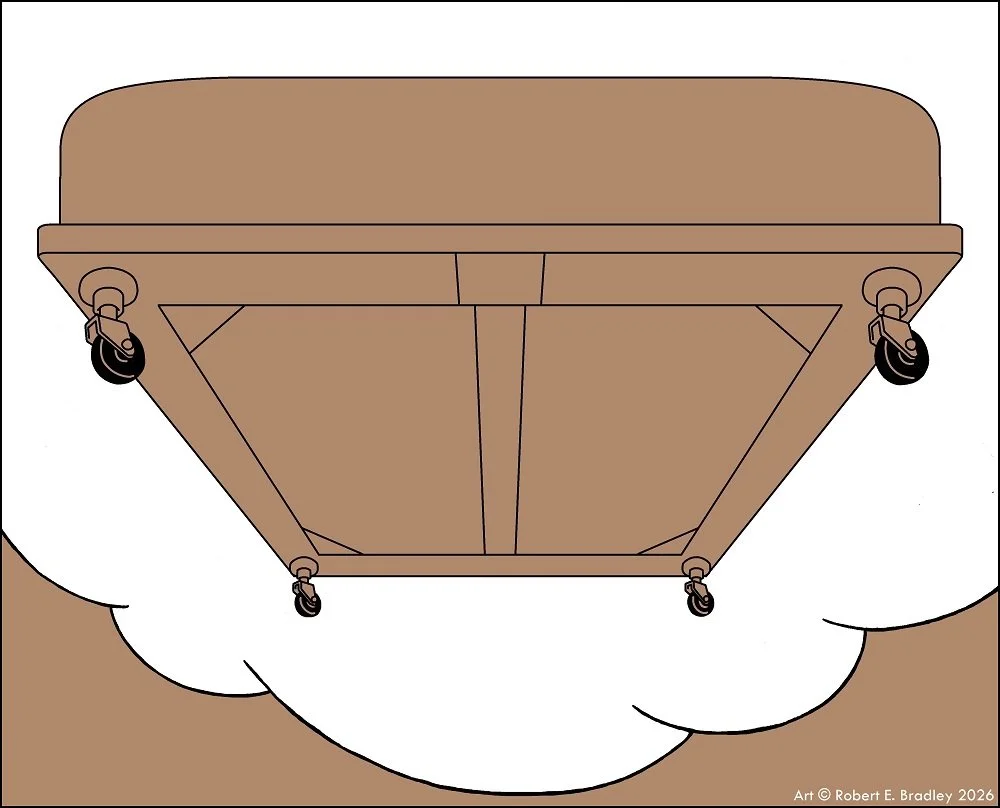
“racked it’s brains”
A rather odd and morbid phrase to use for a character that does not have a literal biological brain. Disch also used the phrase in The M.D.
“what kind of carriage can you build with a single wheel that is one and a half inches in diameter”
Here, the narrator addresses the reader to think of an answer, though it appears to be more of a rhetorical question.
This is another parallel element shared by Alice’s Adventures in Wonderland in which the narrator does something similar, occurring in such places as the first chapter when Alice attempts to curtsy as she is falling and in the third chapter when the caucus race is about to begin.(52) The narrator also addresses the reader throughout Through the Looking Glass.(53)
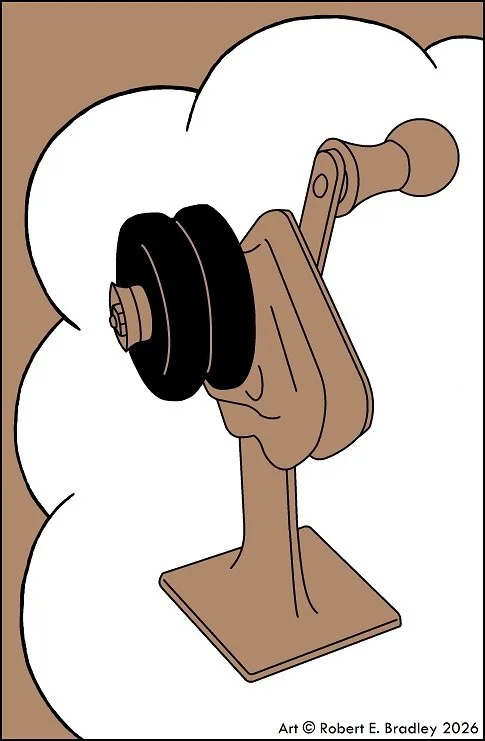
“one Friday”
Assuming the previous dates and the math are correct, taking into account the inferred dates later on, this could be the 30th of July, or the 6th, 13th, 20th, 27th of August 1976.
“toaster had been waiting for”
The early draft concludes this sentence with:
“...the idea the toaster had been waiting for came to it, as easily and naturally as a slice of bread sliding into its slots.”(54)
“if it had still possessed its original wheels”
The two objects of the mattress’s castor wheels and the wheel-less office chair, both useless to reaching their master on their own, converge to solve the carriage part of the travel problem.
“Interchangeable parts are such a blessing”
Another example of foreshadowing which comes into play in part five.
“their carriage”
In the Family outline, their carriage was a wagon.(55)
The use of unconventional modes of transportation is also seen in Disch’s novel The Businessman where a grocery cart is utilized for two characters to get around.
“every extension cord in the cottage”
The appliances now come up against the final hurdle to setting off for the city; a portable power source.
As an aside, there seems to be a symbolic reluctance on the part of both the appliances and the mother-like cottage to part, the extension cords becoming umbilical in nature. A somewhat similar reluctance occurs in Disch’s short story The Birds.
Also, one of the micro stories contained in Disch’s short story The Complete Short Stories is titled The Extension Cord.
The image of cords, along with outlets and plugs, also appear in his short story At the Pleasure Center.
SECTION SEVEN
“Let’s get together before we get much older”
The Who
“The radio looked hurt”
This brings up a major question. How does an appliance show expression? Is it with literal faces or is it in a way only other appliances can read emotions?
Karen Schmidt, illustrator of the 1986 Doubleday/Grafton edition, went with the former approach whereas Hideo Azuma, illustrator of both its Japanese translation debut in the December 1981 issue of S-F magazine and the 1987 Hayakawa edition, went with the latter.
What were Disch’s thoughts on the matter? In a letter dated March 24, 1981 he typed the following:
“No anthropomorphizations (is that really a word?): no faces on lamps or radios; just their basic unadorned friendly presence amid the scenes of their adventures.”(56)
Though, interestingly, in a note Schmidt sent to Disch, written on January 16, 1986, (she wrote 1985 though that’s most likely a mistake since she mentions the illustrations being completed and, since she was first assigned the job in 1985 could not have completed the ten pencil drawings and the color illustration for the cover in sixteen days) she states:
“I’m glad that our ideas of how the characters should look were similar.”(57)
Had Disch’s opinion changed in the four or so years since his initial stance or had he simply been more permissive of Schmidt’s artistic choice?
“weeks of worry”
This implies, again with the previous dates in mind and the prolonged search for the right mode of transportation, that now it is towards the end of August or the start of September.
“It’s our problem”
At the first sign of inter-appliance tension, the toaster makes a swift move to course correct the group back towards perusing their goal in harmony.
“It’s dark and musty and filled with spiders”
The mere mention of the lean-to shed evokes strong unpleasant feelings in the blanket and the potential harm it might come to. If this piece of dialog is interpreted in that way, this serves as foreshadowing for it.
“a big, black, boxy thing”
It would make sense that, due to its limited wattage, the tensor would not be able to make out if what it saw was a battery or not, especially if it could not get close enough for a better inspection.
“red cylinders”
The batteries the radio once had, which more than likely were D cells, that’s color is described here by the lamp could have been a few specific brands that predominately used the color red on their label design in the mid-twentieth century, three examples being RCA, Eveready, and Maxwell.
“lean-to”
In the Family outline, the battery was found in the basement.(58)
“Volkswagen”
In his autobiography, Disch mentioned how he was employed as “trainee copywriter at Doyle Dane Bernbach, the company famous for selling Volkswagens to America.”(59)
Disch also utilized the same brand name in his short stories The Pressure of Time and Mutability.
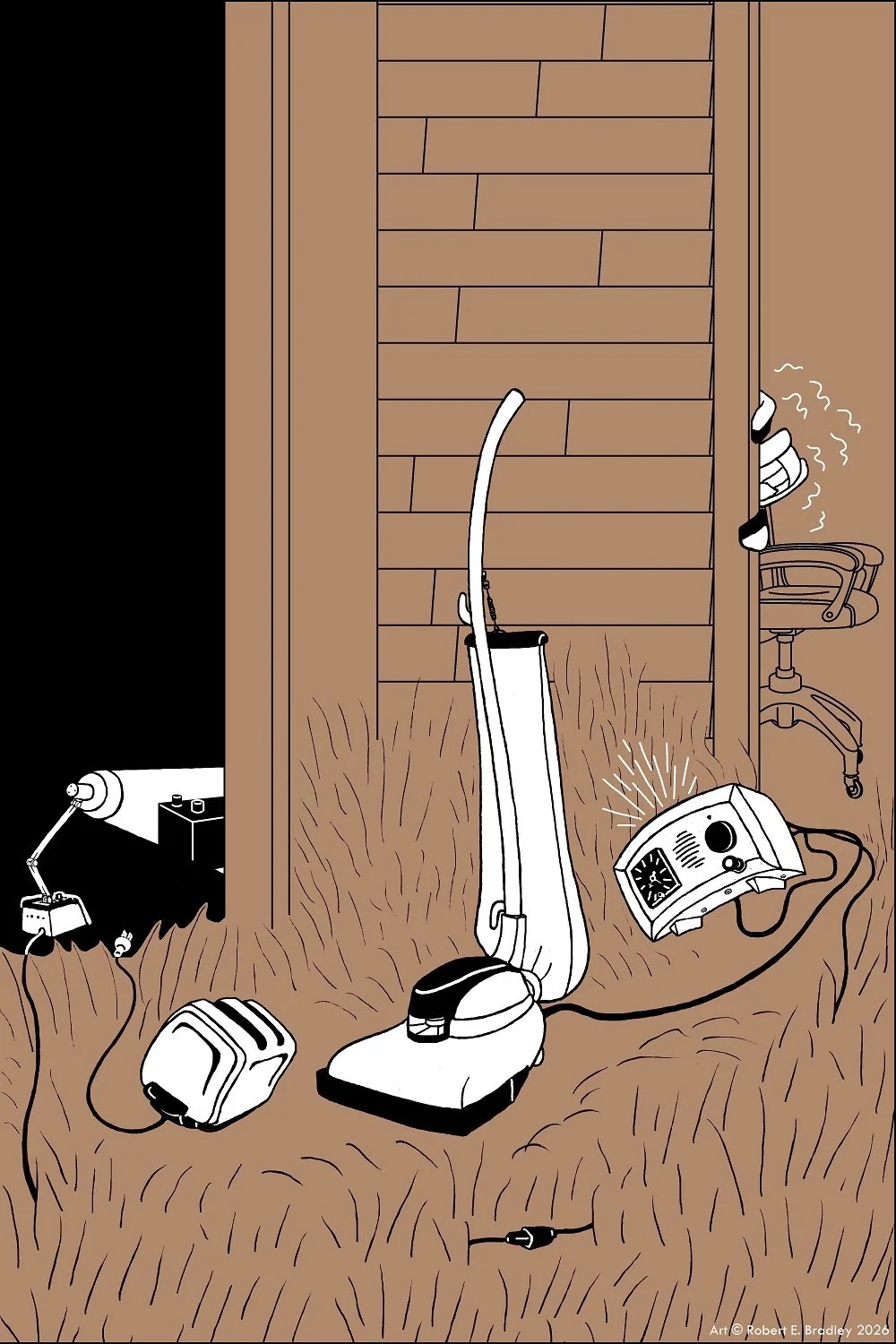
“he’d decided to trade in the VW on a yellow Saab”
An additional subtle use of foreshadowing that corresponds with passages in both the fourth and sixth parts. Also note the continued use of the color yellow.
“the old Hoover and the toaster knew enough about the basic principles of electricity”
One could suppose the Hoover, stated as the eldest, as having been around long enough to have some level of experience though it is curious that the toaster, being the stated youngest of the group, would have more knowledge on the subject than the middle three.
“ask a major appliance”
This last half of the paragraph is a yet another parallel to the Alice books. In Wonderland, the narrator goes on an aside, as Alice inspects a bottle for being marked as poison, about “several nice little stories” where children fail to follow basic rules about things such as “that a red-hot poker will burn you if you hold it too long; and that if you cut your finger very deeply with a knife, it usually bleeds” and that “if you drink much from a bottle marked ‘poison,’ it is almost certain to disagree with you, sooner or later.”(60)
Disch would also apply a similar didactic digression in his short story The Revelation:
“’I think you could eat a more balanced diet,’ God answered. ‘Cut out the cholesterol, and reduce your starches. Get more roughage. And Vitamin C, at least five hundred milligrams a day. Vitamin C is great stuff.’”(61)
As well as the short story This Little Pig Had None:
“Never, she would advise the younger animals of the barnyard, eat more than you absolutely must. And never get so out of shape you can’t squeeze under a fence. Observe those two fundamental laws of Diet and Exercise and, so Mrs. Pinkham promised, you would never be carted off to the slaughterhouse.”(62)
And in his novella The Voyage of the Proteus:
“‘That’s why I say again: do not be imprudent in what you write. Do not offend the Agamemnons of this world.’”(63)
SECTION EIGHT
“The first thing I met was a fly with a buzz”
America
“in the faraway city where he lived”
In place of the latter half of this sentence, included in the early draft was this passage:
“And so they set off to find their master. The path began at the back of the cottage, behind the sad tangle of what used to be the vegetable garden and very soon the dear little summer cottage was lost from sight behind a dense tangle of leaves and branches. Though it was the middle of a cloudless afternoon the forest seemed darker than the inside of a house.”(64)
Something to note is that a reason that the appliances would more likely exit from the back of the cottage, as the deleted passage implied, is that the front steps of most houses have at least one step, usually more, which would cause a bit of difficulty with objects on wheels. The cottage’s back door was probably closer to, if not completely level with, the ground.
The imagery of passing through a back door and of a vegetable garden behind a house would be utilized in three of Disch’s short stories, the former in both Bone of Contention and The Late Movie and the latter in The Invisible Woman.
“lost from sight behind the leaves”
In Disch’s short story Genetic Coda the protagonist, who had been housebound for all his life, enters the outside world and heads city bound with a “heart dilated with the utmost joy” as he “stepped across the boundaries of the absent fence for the first time in his life.”(65)
In the novel On Wings of Song the narrator describes the protagonist’s feelings upon leaving his home for the first time, also on route to a city:
“It was scary—but also, for that reason, exciting—to think of going across the boarder, and there comes a time in your life when you have to do something that is scary in this particular way.”(66)
The protagonist of Clara Reeve also comments on the passing of thresholds:
“What the wayfarer fears, peering into the dark wood, is the Unknown, while I had a perfectly clear conception of what I feared, even as, in another sense, I hurried towards it.”(67)
The protagonist of The Happy Turnip declares this as it also heads for a city:
“’Farewell, old furrows!’ Pink Wonder thought. ‘So long, soil of my birth! I’ll never see you again.”(68)
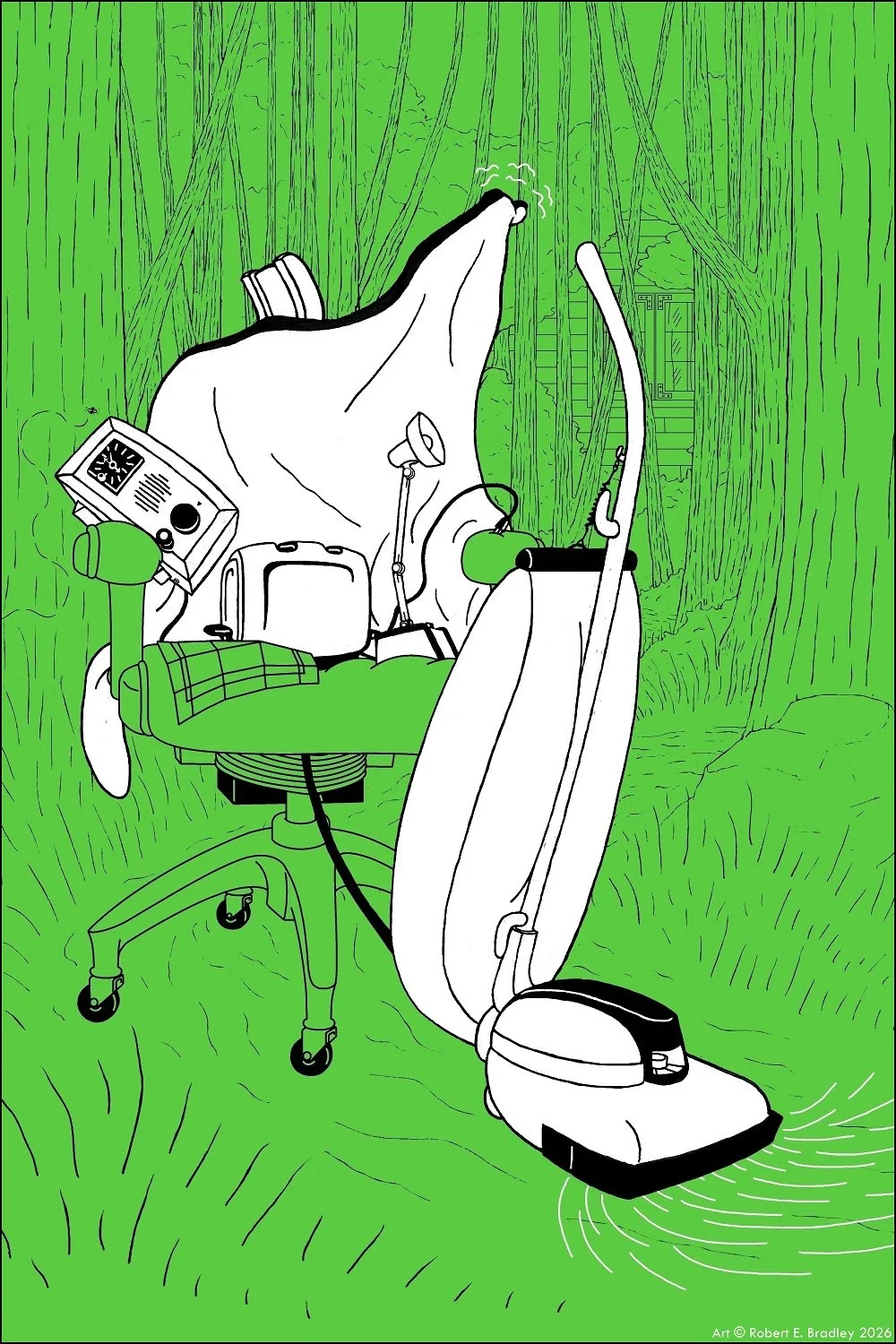
“The road map they had brought with them proved quite useless”
Characters having difficulty traversing by map also occurred in Disch’s short story The Late Movie and the novels The Priest and The Word of God.
Also, Keep this in mind for section thirteen in part four.
“directly into the city”
With the mention of considering the highway, the most straightforward route to the master as with telephoning him back in section five, the small appliances (the readers) are wondering why not go that way. As the story continues, it will educate them on how all electrical appliances live and conduct themselves in the human world.
“must remain perfectly still”
This explanation as to why appliances never reveal themselves as alive to people will also serve as a set-up to plot points in both parts four and five.
“the danger of pirates”
And here another set-up is made. A rather ominous foreshadowing that establishes one of the potential threats the appliances could run into. In fairy tales of the past a being of such menace would take on the form of a monster like a big bad wolf, an ogre, or a giant.
In the early draft Disch initially used the word “kidnappers.”(69) The plot of his earlier short story Three Points on the Demographic Curve concerns a kidnapper.
“refuse to think any more of it”
This is a phrase Disch often used in his fiction when an unpleasant train of thought must be derailed (pun not intended) in order for the story to continue.
“What a lesson for us all”
A not-so-subtle nudge to the small appliances on model behavior (pun also not intended).
“strange and interesting and full of new information”
In an interview published in Eternity in 1973, Disch commented on the impact travel had on his life:
“I’ve profited more, I think, from travelling. A great many writers who begin to publish young use travel as a kind of experiencing accelerator. Or surrogate? Travel forces one to be a better observer. One is always forming and discarding theories, tastes, friendships. The danger of such liveliness is that one may lose touch with what is central, but one may lose touch without even stirring from the shore of Walden Pond.”(70)
He went into further detail one of these journeys in his autobiography in 1986.
“To make my money go further and from a simple appetite to see the world, I went to Mexico to write my novel [The Genocides], renting a villa that had been previously rented by the editor of the Magazine of Fantasy and Science-Fiction, Avram Davidson. It was in the town of Amecameca, situated an hour’s bus-ride south of Mexico City between the two volcanoes Popocatepetl and Ixtacihuatl. Aside from two Mormon missionaries who shared the same walled garden with me, I was the only American in the town. I arrived speaking no Spanish and learned little. I wrote until my typewriter broke down and then I bought another Olivetti from one of the missionaries (equipped with a cedilla c and pinon n).”(71)
“I celebrated [my twenty fifth birthday] by becoming, briefly, a beach bum on one of the Pacific beaches, and there took up with a wonderful con-man-cum-adventurer and his girlfriend who were taking a van to British Honduras, where they hoped to trade it for a sailboat. I went with them through Guatemala, basking in the reflected glory of their raffishness, sailed up a jungle river on a concrete barge, got taken up by a Pentecostal missionary, and rounded off my rite of passage with a visit to the Yucatán peninsula. At last I’d entered the ‘60s (though really it was more the case that at last I’d entered my twenties). It seems to me that such an itinerary is no longer one of the options open to the young—unless they decide to become mercenary soldiers.”(72)
“I abandoned my self-made Trappist cloister in Amecameca and sampled the official ‘artists’s colony’ of San Miguel de Allende, but though there were plenty of people there who spoke English, and a few who claimed to be writers, none of them seemed at all appreciative of the fact that I was a bona fide novelist. Enough of such drunks and wastrels! Enough of Mexico and Spanish irregular verbs! I booked a passage on a passage liner and sailed back to New York in triumph...”(73)
A passage in Clara Reeve also comments on the impact of travel as the protagonist attests:
“...nothing in my life prepared me for the experience, at once exhilarating and terrible, of hurtling forwards in space at such prodigious speeds...my notions of the Possible were firmly grounded in the bedrock of precedent. Now that bedrock heaved, my notions crumbled, and I was borne along, amazed, through the realm of the Impossible, a country of dreams, at a velocity of forty miles an hour!”(74)
“It did an imitation”
Of course, the radio has to be using the car battery’s energy in order to do this. Other than the Hoover, the others have no need to use its power, at least not in the middle of the day.
“Coca-Cola and Esso”
Product brands, as with ones such as Hoover and Sunbeam, are something Disch liked to sprinkle throughout his works. This is more than likely a carry over from his days as a copywriter.(75) Characters in both A Kiss Goodbye and The New Me also share this occupation.
Advertisements, in various forms, mostly comical, also appear in short stories like The Fire Began to Burn the Stick, The Stick Began to Beat the Dog and novels like The Word of God.
“more confident and cheerful”
This belies their inner anxiety of the newness of their environment that they stand in total juxtaposition to. The radio’s recital is merely its personal coping mechanism.
Characters in both The Beginning of April or the End of March and The Invisible Woman also use a radio to alleviate a similar feeling.
“ostensibly”
According to Merriam-Webster, the definition that fits this context would be “to all outward appearances.”(76)
“how filthy this forest is”
The Hoover displays its obsession with cleanliness which is an echo of the marketing behind manufacturers and sellers of vacuums in the early to mid-twentieth century.
In a reversal of perspective, one character in This Little Pig Had None expresses the opposite view of the forest in comparison to her home.
“I feel renewed, as if I’d just come out of my original box”
In place of this, the early draft uses the phrase “’as though I’d just come off the assembly line.’”(77)
The protagonist’s aunt in Clara Reeve feels a similar sense of rejuvenation:
“Travel, whether to the Pole, the Amazon, or Venice, can indeed effect wonderful cures. Like most entrenched Londoners, my aunt Jerningham had settled into a too torpid a way of life. The novelty of a foreign city was immediately efficacious: her megrims vanished, her appetite improved, and a general mild contentment settled over her spirit, which took the visible form of a smile, causeless and unconscious, that waxed and waned a dozen times each hour.”(78)
“picnics”
In This Little Pig Had None, the main character, who takes her first stroll into some nearby woods, also makes a similar association with the forest and picnics.
“Won’t the trees work like a roof”
A seeming reference to the deleted passage at the beginning of this section remains in the final story.
“They keep the sunlight out well enough”
A perfect display of the ignorance of beings who have lived a literal sheltered existence up till this moment.
“They all got more or less wet”
The first instance of hardship, barring the load the Hoover is hauling, that the appliances have been subject to. Here they get a taste of what the air conditioner had to deal with on similar rainy days.
Speaking of the air conditioner, this also foreshadows the signs of visible decay that they will have later on in both parts three and four.
And speaking of foreshadowing, this is not the last time the travelers will have to contend with rain as will be seen, once again, in those future parts.
Rain often makes itself known in Disch’s work, this includes short stories such as The Double-Timer, The Invisible Woman, and novels like The Word of God.
“muddy path”
A foreshadowing of an incident that will occur in part four.
“flowers”
An establishment to the toaster’s incoming encounter.
“need for solitude”
The toaster is not open to additional interaction which it will shortly be falling into.
“Charming flower”
In the original 1980 F&SF publication, the 1981 and 1982 anthology versions, and the 2009 F&SF reprint, the poetry/dialog is in plain text. Oddly in it’s 1981 publication ellipses are occasionally added to either the start or end of the verses, which were not present in the initial 1980 printing. In the 1986 illustrated edition all of the poetry/dialog is italicized.
“pressing its petaled face”
Unless this is an exception, wildflowers are particularly forward when meeting other flowers.
“the toaster’s gleaming chrome”
The daisy must also be dazzled by the sunlight reflected in the toaster. This is probably why the daisy wondered if the toaster sprang from the “sky above” in the preceding verse.
“say any absurd thing that would help them to rhyme”
The way the daisy’s dialog is presented, where the rhyme of a word from the previous line is often the first word of what would be the next sentence if spoken normally, would be reused in another poem by Disch titled The Moon on the Crest of the New-Fallen Snow which also shares the theme, as will be shown here, of the fleetingness of existence in the face of the rapidly passing time.
“speak in verse”
In My Life as a Child, Disch wrote of his personal history with poetry:
“Central [High School] was a good school, and I had some very good teachers there, including, in my junior year, the best English teacher I’ve ever had, Miss Jeannette Cochran. That was the year I discovered poetry. Of course, poetry had been served up in the English textbooks I’d studied, and I had been required to memorize some of these grade school standbys, including a lot of Longfellow.”(79)
“[I]t dawned on me that poetry amounted to a whole lot more than that, that poetry was ordinary language gone to heaven—and I could go there with it! I read Shakespeare. I read Alexander Pope. I read The Rubáiyát of Omarl Khayyám and “The Love Song of J. Alfred Prufrock.” But more than that, I memorized them.”(80)
“[B]y the end of the year...[I had] become, in the process, a poet myself, having written a drama of several pages in rhyming verse and my required junior year essay on the subject of Alexander Pope’s use of the heroic couplet. Since then I’ve published something over five hundred poems in all kinds of magazines, from Poetry to Isaac Asimov’s Science Fiction Magazine and AMAZING® Stories.”(81)
“[W]riting poetry is not necessarily a rare and special accomplishment. Anybody who is reading this already has the required ability, which is simply a command of the English language. Poetry is an art, like dancing, that’s available to anyone with the urge to perform.”(82)
“a rough sort of octosyllabic doggerel”
According to Merriam-Webster the word doggerel can either mean “loosely styled and irregular in measure especially for burlesque or comic effect” or “marked by triviality or inferiority.” Given the story’s context, it is most likely the latter meaning that is being inferred.(83)
“sestinas”
A sestina is “a lyrical fixed form consisting of six 6-line usually unrhymed stanzas in which the end words of the first stanza recur as end words of the following five stanzas in a successively rotating order and as the middle and end words of the three verses of the concluding tercet.”(84)
“rondeaux”
A rondeau is defined as “a fixed form of verse based on two rhyme sounds and consisting usually of 13 lines in three stanzas with the opening words of the first line of the first stanza used as an independent refrain after the second and third stanzas.”(85)
“villanelles”
A villanelle is “a chiefly French verse form running on two rhymes and consisting typically of five tercets and a quatrain in which the first and third lines of the opening tercet recur alternately at the end of the other tercets and together as the last two lines of the quatrain.”(86)
“highest order”
At least twelve different publishers turned down The Brave Little Toaster from the years 1977 to 1979 and, after its publication in MF&SF, 1981 to 1982. Over and over several observations were made regarding the various publishers’ issues with Disch’s story.
One highlighted this passage as an example of the story being “extremely adult” and that “older picture book readers would find it complicated – the jokes are very sophisticated, and the vocabulary is difficult.”(87)
Another rejected it on similar grounds, citing “[t]he charm and the whimsical humor are really for adults — but I can’t see how to market the tale as an adult book. So, it seems fall awkwardly between two markets, which is a pity, but a fact.”(88)
An additional contention with editors was the story’s length (being either too short or too long depending on the department that was considering it).(89)
In one correspondence with yet another would-have-been publisher, they related this anecdote to Disch:
“It ended up that everyone here--and I mean everyone--read it and there was a full scale debate over it, with six editors in beautiful discord. So, if it makes you feel any better, you sowed seeds of strife.”(90)
Disch often spoke of his gripes about the multiple failed attempts to get Toaster put to print as a children’s book. In addition to the already mentioned points, he wrote on the subject further in My Life as a Child.
In that essay he described a conversation he had with one editor and was given the explanation that “(1) it was too well written, so much so that she had enjoyed reading it herself, and (2) children wouldn’t accept the basic premise that appliances can do things by themselves and talk to each other. Mice, okay. Rabbits, okay. Even dolls, okay. But not toasters and radios even though most radios are notorious chatterboxes.
“I don’t think I have to argue with that editor’s reason (2), since it is now a pretty well established fact that the appliances who wash our dishes and vacuum our rugs and toast slices of bread for us are just as capable of having feelings and having fun as mice and rabbits and dolls. But her reason (1) is still a major aggravation for me, since I refuse to believe that a writer has to write in a special, slightly brain-damaged way when he writes for children, always taking care to keep sentences uncomplicated and not to use long words and to avoid writing anything a grown-up could also enjoy. These rules applied (the editor explained to me) especially to fantasies like The Brave Little Toaster, because fantasy is for very young children, five-or six-year-olds, while older children, who’d be capable of reading my book, would have outgrown fantasy and they would want to read realistic stories about the kind of problems adolescents face in the real world, like drug abuse and prejudice and poverty. Now those are real problems, and a good storyteller will know how to write good stories about such matters, but it simply isn’t true that kids stop enjoying fantasy as soon as they start having acne problems.”(91)
In an interview for Last Wave he said that he “only published [Toaster] in F&SF once it had been turned down enough places and I figured, let’s give it some attention.”(92)
“The daisy”
Something interesting to note about the daisy is that despite the fact that by its nature as a flower, with both male and female reproductive parts, Disch designates the daisy as an “it”. The only explanation that could be made is that though flowers are not sexless, the concept of gender does not apply to them.
The subject of gender will be further explored in part three.
In another parallel to the Alice books, the imagery of daisies occurs in both Wonderland and Looking-Glass.
“fallen in love”
Quite the opposite reaction to the title protagonist compared to the flowers in Through the Looking-Glass where Alice, who is also mistaken for a flower, is criticized and even insulted by them.(93)
Though the daisy’s being in love might be the fact that it does not realize that what it admires is not actually a flower. Consider the plant protagonist in Disch’s short story The Wandering Jew in which it displays an overt disdain for electrical appliances.
The theme of love at first sight also occurred in his short story An Italian Lesson.
“its own reflection”
This marks the first of three incidents where someone gazing upon the toaster does not see the toaster but themselves and, on top of that, think they see not themselves but someone else. These incidents will end up causing despair, confusion, and fear to the respective characters. Though the narrator points this out here, the toaster itself will not be aware of why the daisy is so enamored with it till the second incident which occurs in part three in section ten.
“paradox”
The story will come back to this concept in section sixteen in part five.
“the basis for the most impassioned love”
This is most likely a reference to the ancient Greek myth of Narcissus, the hunter who falls in love with his own reflection in a pool of water.
Greco-Roman mythology will be further alluded to towards the end of part four and throughout part five.
“as though in the grip of cyclone winds”
A similar simile is also used in both of Disch’s short stories Concepts and An Italian Lesson.
“such immoderate behavior”
The toaster must have witnessed such floral behavior of those among the flowerbeds outside the cottage that were mentioned in passing in section six.
The protagonist in Disch’s short story The Vamp is confronted with advances of a like nature.
“our lives are but a day”
Here the daisy brings up not only the passage of time but also alludes to death.
“That single perfect coiling root”
Here the running theme of perspective comes up again. The daisy, not being an appliance, can only perceive the toaster’s electric cord as something relevant to its everyday plant existence, in this case a root.
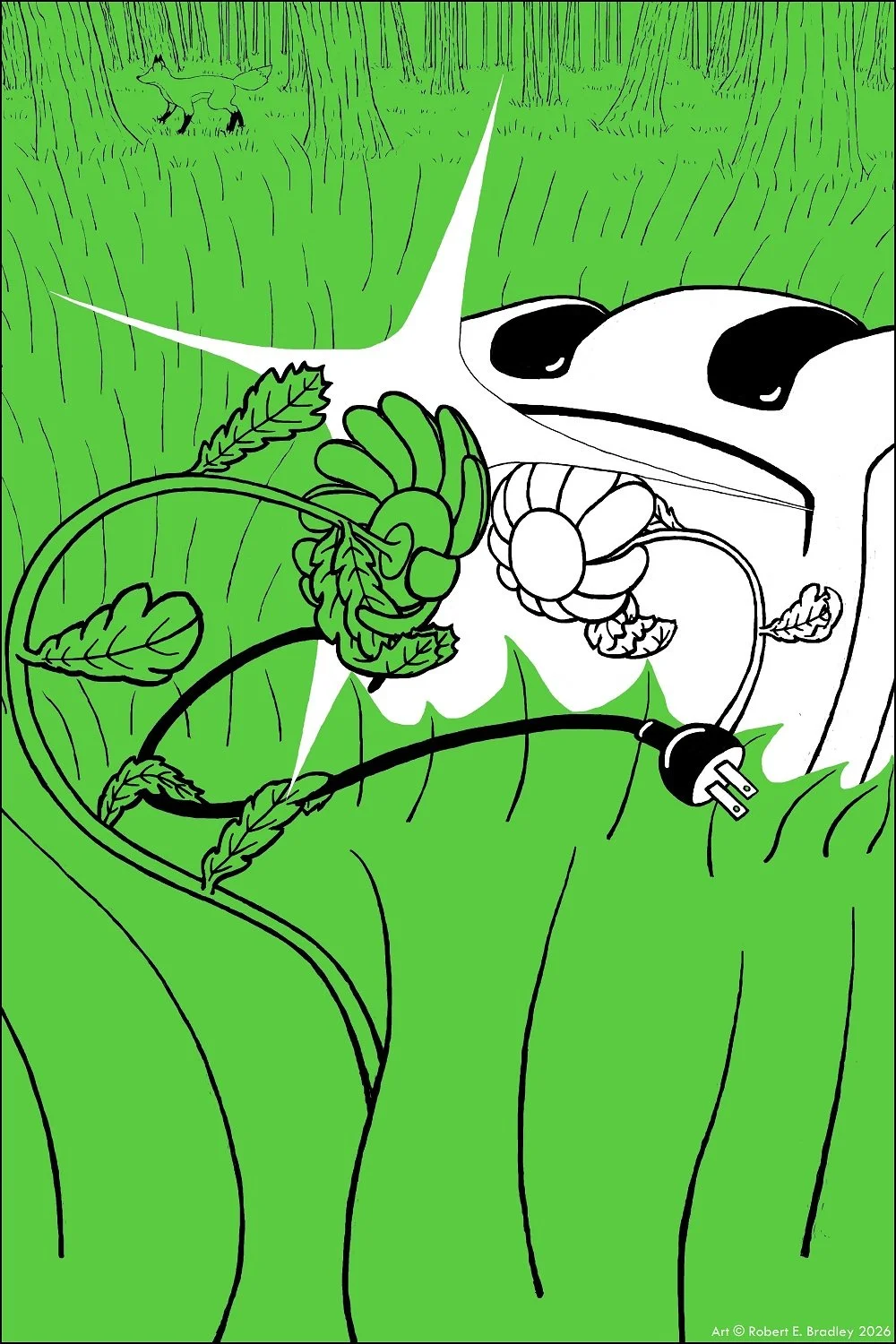
“scarcely know each other”
This phrase also appears in Disch’s expanded edition of his short story The Pressure of Time as well as in his novel A Troll of Surewould Forest.
“misapprehension”
The theme of mistaken identity also occurs in Disch’s novels Clara Reeve and A Troll of Surewould Forest.
“I really must go and join my friends, for we are journeying to our master’s apartment”
The Toaster’s devotion, duty, and determination to reach its master overrides the daisy’s impassioned romantic platitudes. This theme of the struggle between affection and obligation will be further discussed in the following part in section ten.
“such misery”
In Disch’s autobiography he wrote of two love experiences that ended in heartbreak before he met his partner Charles Naylor:
“A week or two short of my twenty-seventh birthday and the completion of Camp Concentration I fell in love. Lee Harwood was a poet, indeed a Penguin poet, the same age as I. Though he had a wife and son, he’d also recently had an affair with a senior American poet, exquisitely memorialized in Lee’s book The Man with Blue Eyes. My memory insists that his complexion (pale with hectically flushed cheeks) was of equal significance with these other facts. For not more than six weeks love was requited, and then Lee explained, firmly but kindly, that our romance was at an end since he was returning to heroin. For a few months I knew an ecstasy of unrequited love that quite dwarfed the fledgling affair that had preceded it, and had ‘nervous breakdowns’ successively in Ireland, Friesland, and Istanbul, where toward the end of ’67 I’d gone to study Turkish by way of preparing myself to write a travel book about the Pontine Mountains of northern Turkey. Why the Pontine Mountains? I’ve no idea, except that they represent the ends of the earth.”(94)
“In New York, in spring of ’69...I fell in love again, and again got ditched four weeks out of the starting gate.”(95)
It appears that due to these experiences, unrequited love abounds in Disch’s work such as his short stories A Kiss Goodbye, Concepts, The Vengeance of Hera, or Monogamy Triumphant, The Pressure of Time, and The Burial Society, as well as his novels On Wings of Song and A Troll of Surewould Forest.
In one instance where the unrequited love is seen through the lover’s eyes, in Concepts, it begins with the protagonist laying on a flowerbed as she searches for someone to connect with till she finds a man living on a distant planet and, at first sight, can’t stop thinking of him despite his clear apathy towards her.
In Clara Reeve the protagonist makes this comment:
“Nothing makes us so insensitive to another’s ills as when they are the foundation of our own happiness.”(96)
“pluck me”
In the Rest outline there is this sentence:
“Flowers will admire themselves in the toaster’s mirror/sides, and urge the appliances to pick them.”(97)
“deaf to reason”
In both The Vamp and The Vengeance of Hera, or Monogamy Triumphant the respective protagonists find themselves in a similar one-way romantic relationship.
In Vengeance an observation is made that sums up the toaster’s side of this experience:
“Besides, it is always delightful to be loved so thoroughly; more delightful, perhaps, in a epicurean way, when the transaction is not reciprocal, for then the beloved will have the presence of mind to marvel at the sweetness of so much unmerited fond attention, instead of vibrating in blissfully unconscious resonance.”(98)
Ultimately, as Disch wrote in A Troll of Surewould Forest, “there’s no arguing with love.”(99)
This brings up another theme in the story, that of the irrationality of biological creatures versus the rationality of electrical appliances and how it governs their respective lives. Although the appliances profess to adhere to this mindset, what has been seen occasionally both previously and what will be seen after this, irrationality creeps into the appliances as they are the product of biological, and thus irrational, beings.
“the toaster hastened”
Here the theme of abandonment emerges again with the toaster doing so to the daisy paralleling the master’s departure from the appliances.
The image of a flower being left behind, usually as a metaphor for a jilted lover, occurred in other Disch stories, those included being The Vengeance of Hera, or Monogamy Triumphant, The Foetus, and The Grown-Up.
“the lamp proposed that they spend the night”
In the Family outline, there is a sentence that specifically evokes an image that coincides with this point in the story:
“Lovely pictures of the lamp at night in a dark field.”(100)
“turned itself on”
The lamp must use the battery, here for the first time, to do so.
“easy-listening music”
Lining up the time of their travel with what is revealed in section eighteen in part six, the song at the top of the Easy Listening chart in the United States that week was the Elton John/Kiki Dee song Don’t Go Breaking My Heart.(101)
“Travel does take it out of you”
Of course, any appliance reading would most likely never know such travel.